Dismiss
Innovation
A platform built for AI
Unified, automated, and ready to turn data into intelligence.
Dismiss
June 16-18, Las Vegas
Pure//Accelerate® 2026
Discover how to unlock the true value of your data.
Dismiss
NVIDIA GTC San Jose 2026
Experience the Everpure difference at GTC
March 16-19 | Booth #935
San Jose McEnery Convention Center
8:27 Video
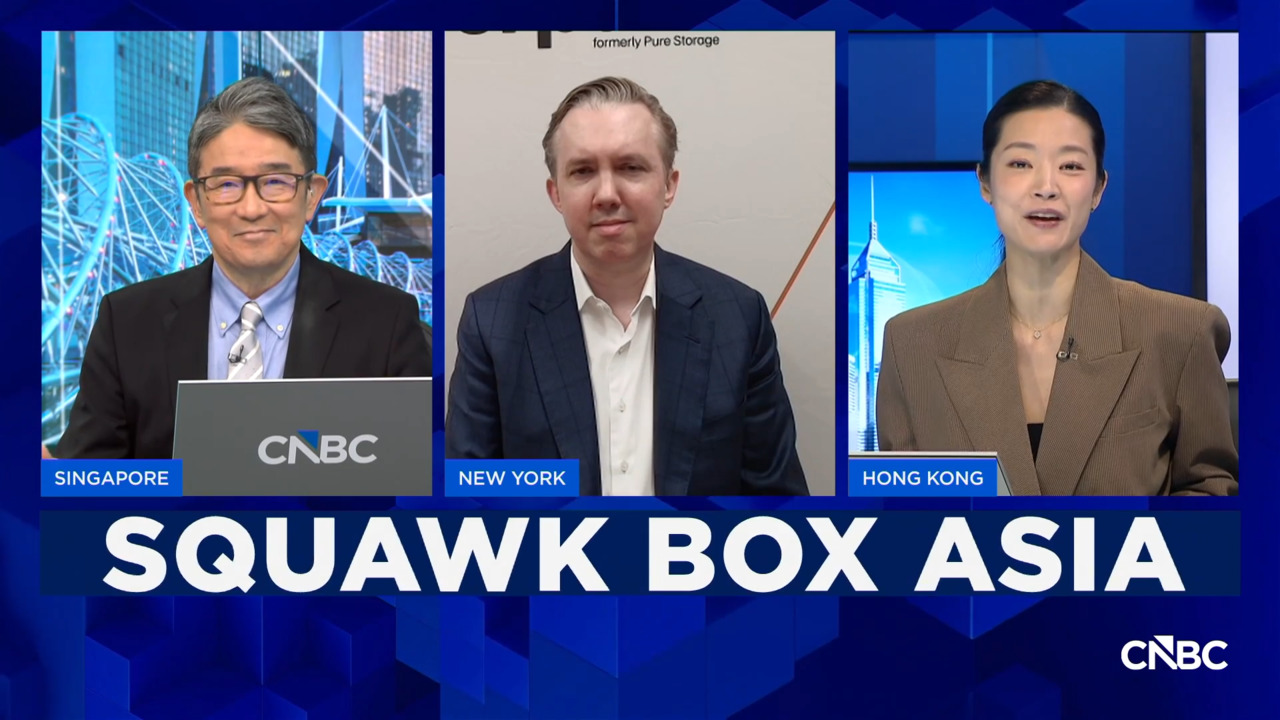
Nathan Hall, GM & VP Asia Pacific & Japan at Everpure on CNBC Asia Squawk Box
Nathan Hall, GM & VP Asia Pacific & Japan at Everpure, appeared on CNBC's Squawk Box Asia to discuss Everpure's strong earnings, the company's new name and evolution to data management leader - along with the reasons behind its intention to acquire 1touch.
Click to View Transcript
Nathan Hull is the vice president and general manager of Asia Pacific and Japan at Everpure, a data storage platform, and have just rebranded from their previous name, Pure Storage. And Nathan, it's great to have you on, so we'll get to the, rebranding part, but let's talk about chips, because we've been talking about chips all this morning with Nvidia
earnings and so on. And I feel like we're sort of in this period where all the AI computing demand is sucking up all the good chips out there, and HBM is really the, the, the sort of the profitable, segment for a lot of these memory chip makers. Maybe they're shunning NAND flashes that, that you need.
Do you feel like prices have gone up in a meaningful way? And what is really the, leadership doing in terms of, bracing for some potential supply chain vulnerabilities here? Well, you know, definitely they've gone up, certainly with HBM, but also with NAND, and it's a common ecosystem, right?
You can't have, GPUs and HBM. with AI, it's basically fueled by data, and so you have to have the data storage, and that's why, NAND is an important part of that ecosystem. And we are certainly witnessing just unprecedented component shortages, and of course, that could lead to extended lead times.
but what we're really seeing across the market is everybody is raising prices. We've raised prices, and although we were the last in our industry to do so, and our increase was the lowest in the industry, but we're seeing that, that nonstop AI demand, and you heard it in the Nvidia results where they're continuing to forecast, you know, robust demand across the rest of the year, also create a same demand in what fuels AI,
which is data storage predominantly delivered by NAND. And are- is how you do your contracts with some of these chip makers changing or evolving in any way because of this sort of different backdrop of AI computing? Well, it's actually very similar in many ways to the shortages that, we saw and many saw
during the pandemic. we witnessed a similar crisis before, where a lot of the hyperscalers ate up a lot of NAND in that space and during that time. for us, we have a platform where we, first of all, have great relationships with suppliers. We have a lot of different, suppliers, and, our technology allows us to very rapidly
change out components as they become short. so that allows us to be a little bit more nimble in the space, and we saw that, you know, maintaining really strong lead times, throughout the pandemic. however, it's, you know, it's certainly true that this is a less predictable market, but what we're confident in is that we are best equipped to weather it.
And let's talk about the rebranding, and, it- it's-- I guess the emphasis is moving sort of away from storage to management. W- what exactly does that do? What is the strategic thinking here? And I wonder if, your If a company is providing a superior
data management service, how does that actually make the user ex- AI user experience a lot different? Well, the, the rebrand really kind of reflects, where our innovation and our portfolio already was, right? We, we weren't just data storage. We'd already evolved into data management, and now the rebrand kind of follows that.
And certainly also with the, you know, our agreement to acquire OneTouch that, that further helps us in that space, accelerating, how we can help customers identify the value of their data and make it ready for AI faster. And what we really see in this space is that that is the opportunity. Consumers have, you know, as I mentioned before, data is really the fuel for AI, and
customers often have their data splintered across lots of different silos. They don't know what their data is, so it's hard to have trusted AI if you can't trust the data you're supplying it with. So that is really, we believe, the opportunity for us and where we're particularly well poised to take advantage of over this next year.
Nathan, I'm glad you brought up, the acquisition of, OneTouch because it's, it's a pretty, big move, for, the company, and you announced it simultaneously as you did, the rebrand. In terms of actual benefits for clients, for customers, are we talking about energy efficiency?
Are we talking about better security, or, or is this more just, based on this move into m- more into management and data orchestration? Well, you know, as your prior, guest mentioned, Chris, you know, AI is certainly, you know, causing lots of energy challenges across the board, and we've been playing in that space with our, our hardware for a while.
We, we are very focused on that. What this acquisition really gets us, accelerates, you know, our existing ability, is around a number of areas. You know, there is-- we see across espe- especially in the Asia Pacific, realm, where data sovereignty is really important.
And so as, as enterprises train or do inference on their data, increasingly it becomes important to ensure that that data is in the right place, that you're not violating things like the new, Korea AI Act or some of the sovereignty, you know, requirements of Indonesia or India's DP- DP Act. So we help in that space.
but the other area is data is generally not ready as is for AI. It has to be trained, prepped, et cetera. And this new technology we have through OneTouch-Actually lets us do that real time when the data is created. So as opposed to waiting weeks as data scientists massage the data and get it prepped
for AI, our customers will have real-time ability to make that data immediately usable for data AI. So there's really multiple dimensions that we're able to, address with this technology. Nathan, we're talking to you, just on the back of, your earnings fiscal '26 and also Q4, and you posted some, good numbers.
I want you to, help us look forward and talk to us about, where you see the key growth drivers, for, Everpure going forward. Is it, AI-driven demand? Is it energy efficiency? Is it more around a subscription-based model or, or, or is it all three?
well, first of all, I wanna thank you for having me on after such robust earnings from us. we had a, you know, record, revenue, a $1 billion, quarter for the first time. and, and where that growth is coming from is also where we see it going and potentially, you know, more in the future, and it's across all of those dimensions.
Certainly AI is, is not going away. Its demand is increasing, and that's fueled, as I've mentioned, by data. across, APJ, and also we see this in, in EMEA as well, data sovereignty and sovereign clouds are becoming much more important. So we're, we're seeing our ability to help customers with that, both in terms of
understanding where their data is and comply with, with new, you know, ever-evolving regulatory landscape. but also that's driving in-country infrastructure as opposed to leveraging clouds from outside countries. there's increasingly neo clouds, sovereign clouds that are requiring infrastructure in
countries, to be deployed. And then finally, here in, in Asia, we're seeing just as a market, the fastest growth, everyone has the fastest growth in subscription-based offerings. and that's because as you see s- you know, more geopolitical changes, unprecedented, changes in supply chain, customers want flexibility, and being subscription is the way
to get that. So we're seeing growth across all of those three dimensions. Nathan, it's great to have you on. Thank you so much for joining us today. That was Nathan Hall from Everpure.


We Also Recommend...
Personalize for Me