Dismiss
Innovations
Everpure Simplifies Enterprise AI with Evergreen//One for AI and Data Stream Beta
Accelerate the transition from pilot to production with benchmark-proven performance, automated data pipelines, and a flexible consumption model.
Dismiss
June 16-18, Las Vegas
Pure Accelerate 2026
Discover how to unlock the true value of your data.
Dismiss
Innovation
A platform built for AI
Unified, automated, and ready to turn data into intelligence.
23:20 Video
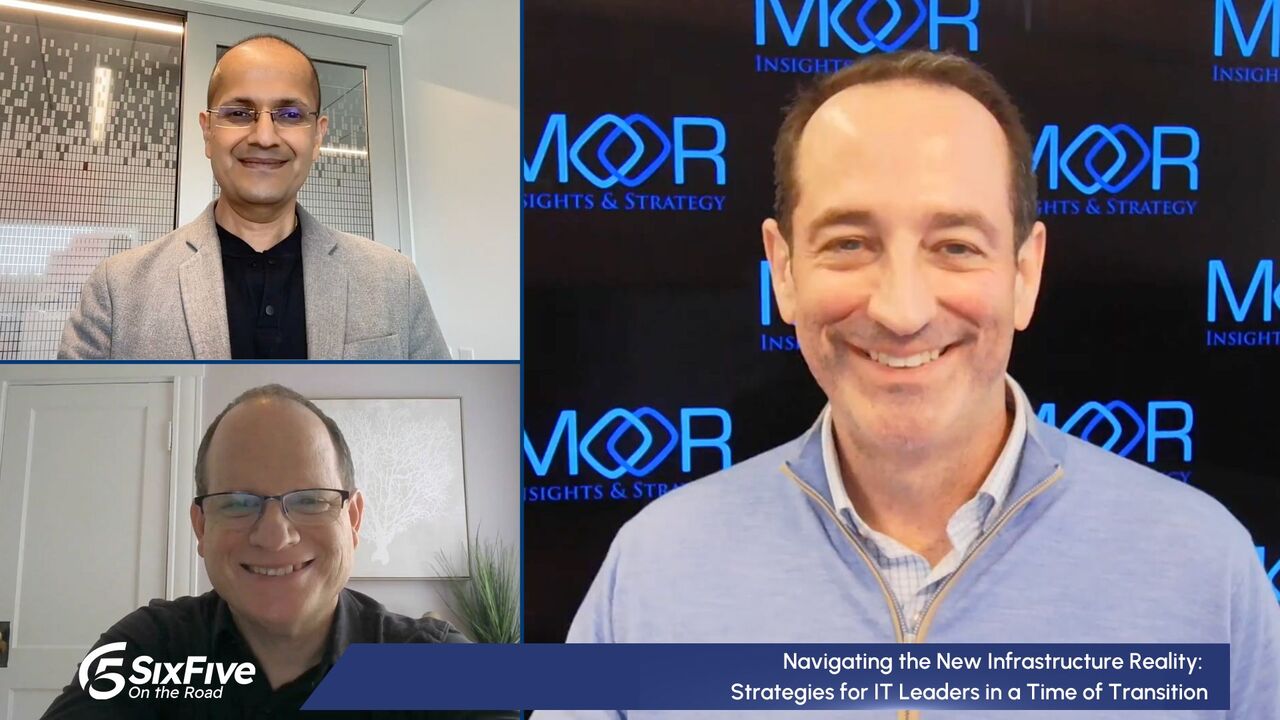
Navigating the New Infrastructure Reality: Strategies for IT Leaders in a Time of Transition
Patrick Moorhead, Everpure's Nirav Sheth, and Presidio's Raphael Meyerowitz discuss post-acquisition enterprise infrastructure, virtualisation, cloud, and workload placement.
Click to View Transcript
The 65 is back, and we are talking about something that I know is on everybody's mind. And that's the shifting landscape out there in the IT community. I mean, change is inevitable, and in some of the most basic things like virtualized workloads and containers, there's a lot of activity going on there. We had Broadcom acquire VMware, and I know I'm talking to a lot of enterprises about
this, and, you know, I get to go to these tech shows, it's like a clown show, right? The analysts show up, and we just go from show to show. There's a lot of discussion. About change here. And what I wanted to talk about is bringing in two guests who are front and center, working with customers.
We have Nav from Pure Storage and Raphael from Presidio. Welcome to the show. Thank you. Yeah, thanks for having us, Patrick, and Rafael super excited, as always, to have a chance to work with you. Yeah, this is again. I know, you know, I always say the best conversations involve,
of course, an analyst, but then, technology firms, but also partners and people who are the closest with the enterprises, and I feel like we have that trifecta going here. So, let's dive right in, and you know, Rafael, I'm gonna hit you up with this first first. What are people saying about the shifts
out there in infrastructure, and you know, a lot of activity with VMware. I mean, you know, I've seen a lot of articles written and a lot of people saying, oh my gosh, this is terrible. I'm pulling the escape hatches, and then last week, Broadcom issued a 25% increase in VMware revenue. Like, what's going on here?
Yeah, so, great to see everyone again. Thanks. We've been a VMware partner at Presidio for over 20 years. Not only have we been a VMware partner, we are also a Pinnacle partner, which is the top nine partners in the US, or Pinnacle partners. The reason I bring that up and why it's important is because we have more and more
customers that have turned to us, net new customers, and we have many, many existing customers. We have over 6,000 existing customers as well. But what's going on is, um, I would say the first, it's been 20 months since the acquisition closed. Things have changed dramatically. Um, there was kind of this fear and doubt in the beginning.
But as customers got used to the, uh, skews that uh, Broadcom had rolled out, they made it a lot easier for customers to consume. It's all subscription now. Customers are already turning to us and saying, how can you help us, not just with VCF projects, but also how can you help us in general with our VMware
environment. Let's not forget VMware has been a staple for many. Many years in customers' environments. Even back to the Diane Greene days, many moons ago, you know, customers were really starting to adopt VMware and we have a ton of VMware customers, a ton of Pure Storage customers that are also using VMware.
N Rav, any thoughts from you? Yeah, so a couple of things. So first off, if I'm, you know, thinking about the customer and partner engagements we're having, obviously Presidio being at the top of the list, you know, I think there's two real significant dynamics that are really causing a complete revamp and
rethink of customer infrastructures, right? One side is obviously what's happening in terms of virtualization and VMware and kind of how to that influence application architecture going forward. I think generally the other side is like all things AI. We can't have a conversation without saying AI, but the demands on the infrastructure resulting from really understanding what that data
strategy looks like, uh, are absolutely unprecedented. And I think any one of those on their own would create a complete rethink for a customer strategy. I think the combination of those two things together, perfect storm. Now, similar to Presidio, you know, for our 13,500 customers around the world,
give or take, uh, most of them in some way, shape or form that are running virtualized environments are running with VMware. Let's, you know, give credit where credit's due. What Ralph mentioned, VMware has built an incredibly amazing business. It's been a pioneer, and it's consistently innovated, but I do think,
Given the transition, the acquisition that has taken place, there are a number of customers that have been surprised. They've been surprised by the licensing. They've been surprised by the renewal costs, um, and it is. It's come in a way that it's not been necessarily expected.
And so if you're a customer and you're planning your budgetary cycles and you've kind of factored in a certain level for licensing renewals and all of a sudden now, you know, that's going to be two, three, five times more, it's gonna further create pressures on other things that you want to do. And so, you know, our strategy and our approach has been a couple of things,
right? You know, we've got these incredible capabilities and integrations with VMware. Uh, and so part of what we want to be able to do is just help our customers absolutely to Ralph's point, just optimize the environment that they have with VMware. Um, but the other side of it is also provide that flexible platform number no matter where
they want to go. But I think these two things combined, uh, are creating a lot of pressures, and we're seeing some customers that are looking to stay the course in terms of VMware, and we are absolutely seeing customers that are trying to rethink, hey, you know, what this might go forward look like. Yeah, talking about pressures, I mean, you, you know, you,
you talked about licensing, uh, changes and, and some of the costs. Uh, Rafael, I'll hit you up with this first. Uh, talk about the financial pressures related to, you know, even, and how they're adapting their strategies, uh, to, to meet not only the business need, keep the lights on,
but also, uh, expand into uh AI and, and meet their budget demands. Yeah, well, look, VMware for many, many years, customers were used to perpetual licenses and buying something called SMS. SNS is basically support. Today, everything with VMware is subscription-based. Um, and that takes, that takes a while for customers to get used to that and used to that
motion. Specifically, because when you think even about our industry that we're in, right, what's happened over the past few years, probably even the past 10 years, a lot of customers are starting To adopt and even adapt to subscription-based technologies. A great example is pure as a service.
It's a subscription-based offering. And when you look at VMware, VMware has a subscription-based offering as well today. Customers are very used to buying perpetual licenses and continuing to use them till the end of time, and now Broadcom's come in and said no, we're simplifying this subscription-based.
And one of the things that has happened is, yes, there are some customers, to Nara's point, where they have seen an increased cost. But it's not sometimes a fair comparison because if you're looking at it on a per CPU basis, a per core basis. For VMware basis.
It's not exactly the same because you're getting a lot more features and functionalities within that VCF stack or within the VVF stack. But also, you're not buying support separately. It's subscription-based and support is included. So whenever I see a lot of the negativity that's in the media around VMware,
some of it is accurate, some of it is not accurate. In fact, most of it. Like we've learned in the media, not analysts, but in the media, a lot of information that's out there is inaccurate and customers are turning to us because they're reading everything that's out there in the media and then we have to come in
there and decipher what's going on and tell them the truth of what's happening. One thing I know about Broadcom is that they are constantly changing. Every single week, there are changes in terms of what is going on. So the media is not necessarily the right place to go, um, to look at kind of what's happening from a financial standpoint with your licenses.
Yeah, so, uh, Nav, um, let's say there are customers who are just unhappy with this. I mean, what are the, what are the alternatives? I mean, obviously there's different virtualization techniques, uh, you want to go full containers or, or something different. Yeah, so a couple things and I love Ralph's kind of, uh, representation of fake news.
It's awesome, Ralph. Ralph, it's great, great to hear that. So, um, but backing that point up, you know, there is absolutely a lot of confusion right now in the market. And I would look at it in a couple of different ways, even if there was no change. To, you know, what Broadcom might be looking at. Customers are always looking for efficiency and
ways to optimize their costs. I mean, it's, you know, in good times and bad times with surprises or no surprises, no customer is ever going to take a look at it and say, oh, I don't want to save costs. Like if there's ways that they can optimize their environment. You know, they're going to seek to optimize
that environment. Now that's exacerbated, you know, because there have been changes and there's no doubt that certain customers are definitely very disappointed by some of the changes, you know, whether or not there's a really good value prop, you know, the change is inevitable and change is tough, right? Um, and so what are the things that you know,
we're engaging on and what we're seeing with our customers. And first and foremost, we know that VMware has a very rich and deep ecosystem and we've built amazing integrations around that ecosystem. And what we want to be able to do is deliver to our customers who are choosing to stay with VMware, a very optimized environment and also an environment that's very, very easy to manage. And so if we think of Vival's capabilities and
VCF 8. If I think of our new VMware assessment capability in our Pure One management platform, which enables customers to really optimize their licensing costs by reducing the number of core accounts they might need to license. If I think of other management capabilities that we've got, uh, within our infrastructure such as Pure Fusion, which enables customers to take a look
at their infrastructure as a pool of assets, uh, rather than array by array. We're striving to enable our customers to deliver and, you know, to enjoy, most specifically, a very cost optimized experience for those that are choosing to stay with VMware. And we've had a number of customers as they re-license, maybe they take out VSA in some way, shape or form,
certainly transitioning out of VXrail, uh, and coming over to us, right? And back to Raff's original point of, hey, we're actually seeing some growth, uh, in terms of customers sticking with VMware. The other side of it, you know, again, in any kind of major transition, and again, I'll go back and I'll talk about AI as well.
Uh, we've, we've got kind of a lot of newer workloads that are emerging, right? And so, as customers navigate, hey, you know, what does my environment look like in terms of virtualization at the same time, you have all of these cloud-native kind of workloads that are emerging that are basically containerized. And so the other angle that we're looking at
and what we've done through the power of our platform is to deliver customers a very flexible capability that's going to be able to accommodate all workload types, right? And so those customers choosing to stay with VMware, we're going to give them a super efficient, super optimized experience, best in class, most performant, and easiest to manage.
You know, some customers might want to take their VMware workloads and transition to a cloud environment, let's say, you know, Azure virtual services and take advantage of the CSP's VMware licensing. Well, we've extended our OS capabilities, our best in class optimization capabilities that run our platforms and extended that into Azure and extended that into AWS, and so many customers can actually continue to work with us,
take their VMware workload close to the cloud, and actually have a tremendous amount of cost savings, you know, in that Azure block or AWS block environment. Uh, we're also seeing customers evaluate alternative paths, right? You know, are there other hypervisor strategies like Hyper-V or Nutanix? In fact, Pure just announced a first-of-a-kind
partnership with Nutanix where, for the first time ever, Nutanix is actually going to be supporting a three-tier architecture for scale and performance, and we're seeing a tremendous amount of customer enthusiasm about that. In fact, you know, Nutanix and myself, we just signed off on yet another customer going into the early access program for that.
Um, and then finally, as I talked about some of these newer workloads, if I think of AI or others, you know, all of these workloads are being containerized and you know, with our Portworx capabilities, you know, we're giving the ability for our customers to have a really resilient and very optimized stack. Um, even if they're completely modernized in that stack.
And so for me, you know, I typically look at things as an and and not an or. You know, there might be certain workloads that a customer sticks with VMware. They might take a look at, you know, other workloads with a potential alternative. Hypervisor and, you know, we kind of know that a lot of their new workloads are going to be architected.
you know, in a containerized, um, you know, kind of fashion, and they're just going modern right out of the gate for those newer workloads. And so for us it's about serving all of the above and not anyone in particular of the above. Right, uh, Rafael, any quick comments on challenges associated with, uh, moves or changes? Yeah, the first thing I want to say to people
is don't panic, OK? Uh, but also don't wait either. I mean, I think that's important, right, because a lot of people wait till the last minute and then then they can figure out what to do. the one thing that I've seen and, Nara, I've kind of covered this as well, is operationally, VMware has been tied into a lot of customers' environments for over 15
years. It's not easy just to move off VMware. And it's certainly not that easy just to figure out, hey, I have a new hypervisor. I'm gonna, even if you look at how many applications have moved to the cloud, not net new applications that are built in the cloud. New applications that have moved to the cloud, it's not that easy.
Imagine now I have to transform also my hypervisor. I have to figure out the dependencies around that hypervisor. There's a lot of things that you have to figure out. So it's not necessarily just about, hey, changing the hypervisor, right? We have a customer that actually went through
this and they just a great example where, um, they actually their load balancers work properly. And they said, all right, we're not doing this. These applications are too important. We're going to stick on VMware. so you have to look at everything, um, within that ecosystem.
And the one thing that I would also say around this is you need to choose a platform like Pure Storage that you can leverage whether you use VMware or that you want to use an alternative. and I covered a lot of those points that whether it's brownfield or greenfield, you can still leverage the same storage platform, and storage is at the end of the day,
the underlying pins of AI so it's really important. And rough, if I can piggyback off that, I think you were kind of alluding to this in your conversation just now. You know, these are not simple decisions. These aren't plug-and-play decisions, no matter how large or small a customer organization might be.
And when a customer is thinking about this journey, I have to believe that pretty much any customer, and certainly any customer we're working with, is thinking about, OK, what is the 2-3 year roadmap of our application architecture, that's no different for us, right? We as Pure are thinking about, what's our 3-3 year journey in terms of,
in-house application architecture, right? Every organization is thinking about this, and I think expertise is so critical to bring to the fold. And one of the reasons I was very excited about doing this session with Ralph is that Presidio has an amazing virtualization workshop, that they're running. That can bring forward all of that
expertise to customers as they think about the road ahead, right, in a very, by the way, neutral stance because while Presidio might have that highest status with VMware, they've also got a multitude of partnerships, right? And same, you know, consideration for Pure, right? You know, please,
please, please think about engaging our experts. We'd love to have a, you know, very kind of advisory style of engagement, and work with your organization to help you understand the road ahead. Similar Presidio and Pure together, you know, our only The objective is to make sure that customers
have successful outcomes, right? We're very proud of our, market leading NPS score, and because we're anchored on outcomes. It's not about, hey, go in this direction or go in that direction. Our platform is flexible enough to serve all directions. Our platform can be consumed in different ways.
You can co-term us with your VMware subscription if you need to, right? And so for us it's about flexibility and choice. And so when you're choosing to engage with Presidio, and you're choosing to engage with Pure, it's genuinely an advisory engagement, let's get you to that right outcome, and let's build that through your strategy together with
you. Yeah, those are great words of wisdom. I, I, I, our listeners or our viewers might be wondering, hey, what is the correlation between storage and VMware? I mean, listen, we're all technophiles, we've been in the industry a long time, but why is storage even in the VMware conversation?
And mate, Rafael, I'd like you to answer this one first. Well, going back even before Pure existed, I think storage remained foundational for VMware environments. If you think about many, many years ago when VMware came out of the motion. It was shared storage that actually enabled that, right?
This was over 20 years ago when that came out. What's happened since then is customers are looking at VMware and saying, well, I need my VMware environment to be fault tolerant, to ensure high availability in case the server dies. I need to make sure that my VM still stays up and that I can recover very, very quickly. That's the underlying
idea behind why customers actually chose shared storage in the first place. Now, the industry has changed, right? If you think about it, there are many, many protocols that have existed now. Fiber channel has been out for a long time in VMware, a lot of different protocols that customers can leverage.
But at the root of it, if customers cannot access their applications as quickly as they need to, or they don't have the amount of storage that's needed, what's gonna happen is the customer is not going to be in business. And I think there's other pieces as well, like if you look at Pure Storage, what's happened is there have been many ransomware attacks that have happened.
Well, Pure Storage has defense mechanisms built in to detect these ransomware attacks before they happen. So the underlying pinnings of storage have evolved over time, and it's become a defense mechanism also for companies, and then also when you factor in AI and the unstructured data that customers
have on the storage side. That's exactly it: if there's no AI without storage today, at the end of the day. I very rarely ask a question that I know the answer to, but I just want to make sure all the viewers out there, understand this. I mean, we would virtualize,
an application that sat on top of a VM and then we virtualize storage, right? And it became important, and then what became important was, and still is, resiliency, right? Which is, particularly now that we're under attack, more every year and potentially, with ransomware. And I'm really glad to see Pure step up and offer these foundational services on top
of, you know, the storage, right? I mean, I know it's a thin delineation between, you know, storage and data now, particularly with all the data services that the storage vendors are offering. But yeah, I just wanted to make sure the audience knew, this, and I appreciate you answering that question.
So both of you, I think, gave a really good view as well on, you know, words of wisdom of how to make that happen and the partnership that the two of you bring. And with that, I just want to thank you for joining us. The thing I really liked about this conversation is it's all about the enterprise wants optionality,
OK? And you guys talked about doubling down on VMware and how you could do that. Rafael, you addressed that, right? How to get through that. And then we addressed, hey, maybe you want to take, you want to look at different things. That's just a reality. That's the way the enterprise is. So really, we hit the gamut here and I just want to thank you.
Uh, thank you for having us. Appreciate it. Thank you. Thank you very much and thank you for the amazing partnership with Presidio. Absolutely, and good luck with the huge event that you have coming up. I've been getting pre-briefings on that, nonstop, and it's been, it's been wonderful.
So thank you very much. Oh, I appreciate it. We're gonna be unleashing a lot of innovation that is right in the wheelhouse of this conversation.
Absolutely. Well, I wanna thank you all for tuning here, uh to the 65, uh, a great conversation about optionality, and in, in the construct of, uh, VMware and some of the changes going on there. I wanna thank, uh, Nav and Raphael, uh, for video from coming on the show.
Tune in, hit that subscribe button, and hit all the content, uh, about Pure that we have out there and all of the storage and data management conversations we've had over the last seven years. Take care. Bye-bye.
What’s the roadmap for enterprise infrastructure in a post-acquisition world? Patrick Moorhead hosts a critical conversation on the evolving enterprise infrastructure landscape. He’s joined by Everpure‘s Nirav Sheth, Vice President, Worldwide Sales & Customer Success Engineering, and Presidio‘s Raphael Meyerowitz, Vice President, Partner Go-to-Market.
This dynamic discussion tackles the profound impact of acquisitions, exploring everything from virtualisation and cloud strategies to optimal workload placement. Key takeaways include:
- VMware Acquisition Impact: They dissect how the VMware acquisition is fundamentally reshaping IT strategies for organisations everywhere. • Evolving Infrastructure: Get a clear picture of the current state and rapid evolution of the enterprise infrastructure landscape.
- Virtualisation & Cloud Strategies: Learn key strategies for navigating virtualisation and cloud adoption in today’s complex IT environment.
- Workload Placement Post-Acquisition: Discover critical considerations for effective workload placement in the wake of significant industry changes.
- Future Outlook for IT Leaders: They share essential insights and a forward-looking perspective for IT leaders grappling with these transformative shifts. Learn more at Everpure and Presidio.
We Also Recommend...
Personalize for Me