Dismiss
June 16-18, Las Vegas
Pure Accelerate 2026
Discover how to unlock the true value of your data.
Dismiss
Innovation
A platform built for AI
Unified, automated, and ready to turn data into intelligence.
Dismiss
The Everpure Advantage
Thrive through volatility
Stop absorbing volatility. With efficiency and predictability built in, you stay in control.
35:38 Video
Nutanix and Everpure: Propelling Enterprise Virtualization Forward
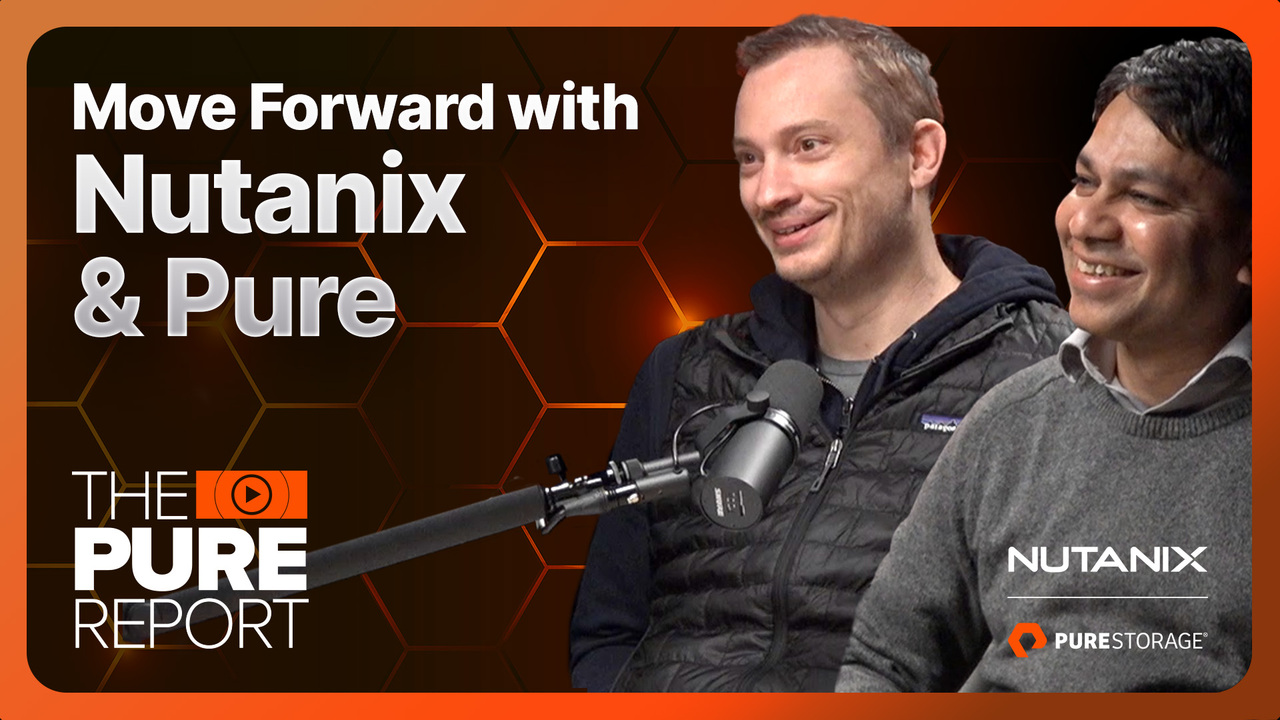
Everpure & Nutanix launch their joint virtualization solution! Guests Ketan Shah & Cody Hosterman dive into the platform, tech, and roadmap.
Click to View Transcript
Greetings and welcome to The Pure Report. I'm your host, Rob Ludeman. And it is time to bring the orange, and we have a super-exciting episode today. We are celebrating the launch and the announcement. Of the Pure and Newanic solution, I'm thrilled to have two guests with us today, Kate and Shaw, VPs of Products at Nanics. Great to have you here.
And Cody Hosterman. I never know your title. It's always changing, but let's go senior Director of Product Management covering many Things. It works for you. Um, hey, welcome! Welcome. Great to have you. Caitan from Newanics. Talk a little bit about what you do there.
And how long you've been at New Tunics before we jump into all this, Uh, great news! Yeah, thank you. Thank you for the very warm welcome, and thank you, Cody, For the partnership. Uh, so I'm Caitan. I lead management at Newtonics for Core Infrastructure Solutions.
I've been here seven years at Newtonics. And my whole career has been kind of a combination of sorts. I started my career in networking, storage, security, and cloud. Virtualization, right? So this role is really a combination of all Those things. And my job is to truly represent the voice of
The customer in the company. That's fantastic! Uh, you're also well-known. We were getting coffee in the break room . And ran into one of our, one of our pure product marketing people, And they knew you. You've been around.
There's a lot of back-and-forth between two companies. Yeah, definitely, definitely here in the Bay Area for sure. Cody, you’ve been here a long, long time already. How many years has it been for you now? Approaching twelve years now. God, 1212. What was it like back, back in your one,
Therefore, I mean, where you are now versus then, I mean, Like a lot of things are similar, you know, um, the branding, Right, it's still fairly similar here, right? No, I mean, Like cultural, culturally, it’s, it’s, you know, things have, I think we kept up fairly well, and I think you know, culture is top-down,
Right? Because still being here and being deeply Involved in the product, business, and the company across the board, Like, it really makes a big difference there. And a lot of things have changed. Right? We're a much bigger company than 12 years ago Years ago in many different ways, uh, um, but, uh, I think the,
The one thing that hasn't changed is customers. Are; we're still really happy with what we're Doing. So, I think we're doing something right. I'm really excited to bring both of you together to discuss this partnership, This announcement, and what I've learned. In researching what we’re going to discuss, there are many similarities between the two.
Companies, right? It's both cultural and with the spirit of Innovation. Is that something Cayden That's come out for you as you've been working with Pure for a while, We'll get into that in a moment—how long we've been talking about this. But what have you noticed about both companies working together on this joint
Solution? Yeah, no, actually, that's a great observation. Right? One of our cultural principles at Newtonics Is; we obsess about our customer success. And that’s what resonates each day I come to work for many of our employees. That's the mission that they drive.
And the way we're approaching the industry is basically to provide a platform to run any Application anywhere, anytime. So, there's never a dull moment. You can help customers with cloud transformation, AI-native transformation, And most recently, the thread that kind of tied us together was this disruption in the Virtualization industry.
So, we talked to some common customers and prospects, and what we found out was obvious. The culture between both companies is very similar, as Cody alluded to. Right? We focus on our customers' success. We both have very high NPS scores, but that feeling is quite mutual. We talked to these customers and partners.
They, you know, found the evangelist and passion champion advocates of pure, just like we find of Newtonics as well. Yeah, it's a great, great connection. So, what are we announcing today? Cody? What’s the big news, uh, Uh, what's coming? We talked about it a little bit.
Right? We made an announcement back at DotNext and In May earlier this year, and there's been a kind of rumble going on, But what's the significance of today? Where we're hitting the, The launch in the GA? I mean, the shortest answer is you can buy it. Now, right? You know, we've been talking,
We've been talking about it for a while, um, but it's now officially GA. Right, is it? So, which is very exciting. Both teams have been working very hard lately. Year or more, really, uh, on building and updating our own platforms, Right? Newonics did a ton of work on their side,
A mountain of work, right? You know, really making sure this is done. Right and integrated in the right way. And we've done work on our side, too, right? On making sure that, Hey, if things weren't properly optimized, or if things weren't in the right way, How do we update the platform? And so, we've brought it together.
Today, we're here to announce it. You can buy it. Deploy it and be successful as of this moment, which is really exciting. And that's what we want: huge success. How did this come together, exactly? You mentioned a year plus. Cody, which still blows me away, 'cause things like that just don’t always seem like they
It shouldn't happen that quickly, but it does. It's how, How well our teams can do the engineering and work jointly together. But what was the origin of this? How did it start, and who was involved? Who called whom, and you know, when do we start dating? I guess it's kind of, it's, it's kind of where I would go with it.
I think the interest was fairly mutual, but it's driven by that common theme of ours Customer centricity. So, the moment the virtualization disruption It started happening, right? We started hearing from our customers. And, uh, I believe you guys also started hearing from your customers, and ultimately, Uh, from our vantage point, customers said, Help me with this choice and alternatives.
Virtualization, but you have to help me and work in my environment. And many of those customers had Pure Storage, right? So, for us, freedom of choice is one of our cornerstone principles. So, it made a ton of sense. We started working and reached out to Pure team, you know.
I definitely have to credit Cody. He’s one of the visionaries and forward thinkers. Thinking leaders in the company that brought us together. But since then, you know, the culture principles and customer passion remain. But also, as the engineering team started working together, There was just a natural DNA of innovation that gelled well together.
Uh, now our field teams are working together, helping customers do their best Intent, right? Yeah, yeah, that's what it's all about. To help with this virtualization optionality, or One of the other words I love using is dilemma. Right? It's kind of where you're going to go, What you’re going to do. Build on that a little more.
How are the engineering teams doing? How have they been working together, and why is it working so well? What is the factor in that? Uh, that, That’s resulted in where we are today? Yeah, I mean, I think from the time that we swiped right,
Left, I don't know; I haven't been in the dating scene, whichever way — it's like this, Yes, yes, um, you're going with the dating, you know, we've been, We've been very deeply engaged, and I think there are a lot of benefits, Right? Is it like our teams are local, Like they're close to one another, right? So we can.
Physically see and work together on whiteboards. We had many sessions very early on about This is how our product works. This is how we operate. This is how to build it right. And very early engineers from both firms who truly understood both stacks were Involved from the get-go, right? I was like,
This is what we'd like to do. This is how we could optimize this. How we could build this, right? So, there's a lot of early collaboration Before anyone started the real typing of the code. To figure out, all right, how do we do this? How do we work through this? And very quickly, we built these personal relationships within the engineering team.
We created the joint Slack channels, right? So we can pepper each other with questions all Day-long, um, which has been, which has been fantastic to have that kind of close level of Collaboration. This is not a 48-hour turnaround on questions. It's, uh, I mean, honestly, the SLA has minutes, I feel like from some of his team, Right, um, which has been absolutely fantastic.
And so, it really feels like this isn't even a, partner engineering collaboration. This is like the same company almost working on this together. Just when the way they're coming at, coming. Coming at it from the same place, just with different products, Right? Different areas of the stack.
Um, but I love the questions their team has been asking us about, Like, how do we—like—this is the outcome we want to achieve. For this is what we want for our customers. How do we best use your product to do it? And vice versa. And so, that level of tight collaboration, I think it has been really, really great to see, and just the,
The agility of shipping code back and forth, and testing and validation. And, um, getting, getting them flash arrays, getting their, Their stack into our labs very quickly, uh, made, made a big difference. And I think, as we move forward too, now that both teams are, Are experts, right, in each other's stacks, like we can,
We can accelerate this partnership as we move forward after GA here. And that's what gets really exciting, right? I mean, first, I think it's important we get it right, Right? We spent the time, we invested, we built the Relationships, as you said, so when we bring this out,
We're confident. That we'll be having that customer. Centricity that you mentioned, we're going to be able to solve those problems. But I do know we're not going to hit on too many of those things today. You know, talk to your respective account teams, but there's a really exciting roadmap for Features and development going forward. This is not just a moment in time where there’s
And the thing that we're pushing out, it's you know, This is the beginning of a really robust relationship with a lot of features Functionality and capabilities we seek to continue solving some of those problems, Some of those challenges for customers. I want to dig in a little bit into the situation, right?
That you referred to, Caden, around the virtual virtualization optionality and its trends. Uh, a couple of stats. I do this stat of the episode thing now. Segment. Um, I can't recall where I pulled these from. Oh no, I pulled these from a recent webinar that we hosted. So, Andrew Miller does this coffee break webinar, which is interesting because you guys
Have your coffee talk, uh, podcast. Uh, we did a poll of the attendees there— a few hundred: 178 respondents. Uh, saw existing VMware pricing rise higher by more than 50%. And 42% responded they would like to see their company move to Newonics. That's actually a really good, interesting stat, and outcome.
Um, Cody, your reaction to the stats here. Yeah, I mean, like, I've done EBC after EBC after EBC. Right? A huge portion of our customers are, Are VMware shops, right? And, uh, forget about the ins and outs of The, this specific acquisition. Like anytime a technology you're deeply
Intertwined with gets, gets acquired, like the company gets acquired. You think about that strategy, and that investment, right? Regardless of everything else that happened around them, The Broadcom and VMware acquisition. And so anyone rationally thinking about their investment in IT was like,
All right, is this the right thing for me? Do I need to change? How does this impact me? All of our customers were experiencing it. Question as well, like, brought up is, what do we do? Do we do anything? And when looking at these alternatives, Um, there's a ton of, I mean, hundreds. I mean,
Honestly, if you really look into it, our focus here was not to create an alternative, Right? It was actually to do something better. Well, we're not trying to ambulance chase here for customers that are just I need something. I need to move, but where to? Like, how do we not only give them something to move to?
But give them something better to move to, right? And this goes back to that point around, you know, Our support, our commitment. And how we can jointly improve it. How can we have our sales team work together, right? And not separately.
Um, and of course, bring in the channel. It's really to drive it home together. And so, I think it's the important piece here is that these customers are not just looking For all right, what was second on my list in 2010, right? It's like, what is a better option for me now that I have the real business, and often Technical impetus to make a new decision or a choice here.
And this is really what has brought us together, And this is what our customers are looking for. And that's why so frequently, I think the Newtonics partnership comes up as preferred For our customers, it's because they're seeing that there’s something real there. Yeah, they're making an investment choice for not just for tomorrow, It's really for 3 to 5 years, or let's call it a decade.
Twenty years—that’s how long they've been running their VMware stacks. Honestly. So, this is something they're taking really Serious look at it, and you make a great point about the acquisition piece. Right? One of my other jobs is running community here. And we have a digital community platform, and it was acquired earlier this year.
And we, within the first week of that event, started looking into the different options. Now our contract renewal is not for 18 months but already we're building a new relationship Contingency, but you just have to do that, right? It's just something, um, that's the nature of it, Of when an acquisition happens.
Uh, what are you hearing from your Newark's customers? It's about this partnership, right? We announced it at dotNext in May. Level of excitement. Did you have people reaching out and saying, You know, when will this be available? We're interested in seeing what it entails. Uh, what's the level of excitement been there, given that,
You know, we almost had half the people in a poll saying they want to move to a Newtonic Solution, and those are mostly all people running Pure Storage already. Yeah, absolutely. So, I'll say a couple of things just to Build on what Cody said, right? One of the things you hit on the nail On the head, customers are looking for a partner for the next decade.
Right? So clearly, they have a problem they want To solve today’s challenge, it's about getting a modern virtualization stack. Software stack. But it's also about ensuring they deliver. Better outcomes, right? So, customers continuously tell us that the Needs of the business far outweigh what they had from a legacy infrastructure view.
So that's part of the work we've done so far from a joint solutioning perspective. Now, coming to the solution we've built, we went through a very robust early access The program was excellent. It was oversubscribed quickly. We had literally, I would say, double digit number of customers across all industries and partners interested.
We ran a very high-touch engagement program. The feedback was overwhelmingly positive. Uh, customers have a lot of confidence through that process in moving forward Solution. Um, we went through industries across Healthcare, financial services, transportation, and service providers, Uh, channel partners.
Um, so, the overwhelming feedback was like customers who knew Newtonics or Pure, Pure, they felt at home with the solution. Right? Uh, that kind of created more excitement within our community of customers. Partners and the field teams. Uh, the other variable here I want to just highlight is Cisco.
Right? So, Cisco has a partnership with, uh, Pure and Cisco have a partnership with Newtonics. So what Cisco is doing is very unique with FlashStack with NetApp. They're bringing the full power of Cisco, with validated designs. So customers gain assurance in networking and full-stack delivery as well
As part of the solution. Uh, but yeah, the excitement level is Something that we haven't seen in a long, long time, with the, With the joint solution, Yeah, I love it. Um, it just means it was the right level of synergy. Cody, what did we learn during the EA? Anything else, or...
You know, Early Access Program? What, anything stand out to you that was? That was interesting, that the teams. Gathered from that, for sure, um, you know, and this is, Um, this is going to be a little cop-out answer, but I’m giving it to you anyway, Um, acceptable is, you know, when we first, when we first met,
Like literally Caiden and I, like, you know, almost two years ago, actually, Really, when he first sat down, it almost felt like a career exit interview. Like, if you were to rebuild, you know, the virtualization storage ecosystem, Like, what would you do? What would you not do? Like, how would you start it off? And so, we really spent a lot of time talking about,
Like, just like the technologies that we've had to kind of band-aid over years. The ones that really drove a lot of value, where we saw the market heading, Um, ecosystem integrations that made sense, and didn't, um. And so we built on that, and we delivered a product to come from those Conversations like, if you were to do this Now, if you were to do what was done 25 years
A while ago, right in virtualization storage business, and then build it from modern roots Technology that we have right now—like, what would you do? And so, we made some assumptions there. We built some swim lines. Uh, customers are used to, they’re used to having them as options, But maybe not the path, right?
And the feedback we got from EA was that it was the right decision. Right? Um, that’s in their testing and what we’ve built. And how we've delivered it is exactly what they wanted to see from this modern platform Integration. And so that was great to see. In the sense that we didn’t get any negatives surprises from the early access,
Right? You know, people find issues, and they have Feedback, sure, right. Natural stuff is part of the reason that we do it, But the most important thing for me out of that EA was a gut check. Like, are we doing the right thing? Are we going down the right path?
Uh, and that answer, I’d say from all of them was yes. And that was wonderful to see, because we all made a big bet on, On how we're building this, it seems like it's paying off. Well, there are always two ways that EAs can go, right? One is just that many things are clunky, and you have to fix things.
And others are, they go, “Oh, this is really great; I like what you did.” But also, have you thought about it, right? Cause then you can get those inputs, And that's, again, what we do as product managers: listen and hear our customers Want, and then build those capabilities into the product to make that even better. And maybe some of those came with the GA version; maybe some of those are roadmap items
That are happening out there in the future. Same question for you. I want your perspective on the EA as well, as Cody talked about it, Just, you know, what you heard and what you've learned since you are representing Customers' needs out there in your role. Yeah, I mean, I think, just to add to what both of you said, right?
So one of the things that surprised us was that we had customers and partners literally tell us They're going to try to break the solution. Another part of VA battle-tested it, Uh, did a lot of failure testing, and overall the resilience of the solution impressed them. To the point that as soon as it goes GA, they want to, You know, go live with the solution. So, that was a good testimonial.
The other aspects of things that we learned that kind of surprised us was networking. We thought networking would be hard, right? One of the big bets we made was, Let's modernize the data center infrastructure with this IP-based storage, focusing on a Low-latency protocol between compute and storage called NVMeTCP. Right? The industry has wanted to move there.
A lot of architects want to move there, and We're both coming together to help propel that Movement forward. Uh, so we found it surprisingly easy. Customers in the past may have been stuck to Fibre Channel. We didn’t see any real objection, and with the work we did, The work Cisco brought to the table, right? We made it very easy to move over to IP.
Based storage. And ultimately, that's the way to the future. Right? There’s not a single workload in the AI cloud. Native world that runs on Fibre Channel right now. We may as well go there now, right? That makes a lot of sense.
Um, I want to dig into this with both of you a little around some of the technical Capabilities. Right? The things you mentioned that we were working on together, which you thought, Well, we should—should we go do this? But also let that be a backdrop to, To help people viewing and listening understand more aspects of this,
And not make this like you're reading data sheet, right? But like that, we actually get your expert technical opinions on. On what we built, and what's cool, and we're going to rapid-fire back and Forth. So, um, Caitan, I wanted to do first a Round. Uh, talk about automatic provisioning,
Right, regarding what customers can do to provision VMs from, From your management interface. What? How does that work? Sure, absolutely. So let me just spend a minute level-setting. What we've built, and then I'll dive in that for sure. Yeah. So, a good place to start.
What we're really introducing is a Newtonics cloud platform integration with Pure Storage flash Array, right? And the way the solution works is this: Newtonic Cloud Platform. Um, which is basically a compute platform. Connecting to Pure Storage over this low latency IP protocol MBMETCP. Now, there were three key design principles we had on the,
On the solution. One was we wanted to leverage its maturity. Everything Newtonics has done, Pure has done over the last decade. And so, that was Principle Number 1. Number 2 was you wanted to really meet customers where they are. Right? And a lot of that was—you know, you can use
Your PR: you can use your servers there in that environment, right? You don't have to buy a bunch of new hardware to change your software stack. Uh, and the third one is we wanted to preserve that better outcome. The simplicity and agility of Newtonics, right? And to your question, right, the way we designed this was for a customer used to
Newtonics basically feels at home. They log into PRISM. They create a virtual machine on AHP. And automatically, we provision the backend disks, the virtual disks from Pure Storage Flash array with automation and integration. All that is done in an app VM-centric way granularity, and the interconnect is obvious
This high-speed, low-latency protocol. Once again, we abstract that, make it all invisible, right? So it's just plumped together. This feels like conversations I had before with you four or five years ago on the podcast It is. There are, right?
And that's what keeps that, what, that's what keeps jumping out. So build on that a little bit relative to the storage side, Right? These are the people who are familiar with this Prism interface and, on the Nutanix side managing storage now, flash array, and all The goodness there. What is it? What does that look like?
Yeah, I mean, we’ve always had this message that we don’t want customers Spending their day connecting ones, right? There should be a storage team. That should not be their job, right? Like, right. Like it’s—it shouldn’t have been for a decade, right? Um. And so that was not something that we’re, we’re, we want our customers doing.
And in this situation, they can't, right? This is, This is the concept of VM centricity, right? This is what the Newtonics platform is built on. Top of mind is something we wanted not only to preserve, but also additionally promote, Right, with how we've built this integration. And so, there are a couple of key pieces, right, one is just back to networking
Stack, like configuring networking best practices for NVMe TCP. That is done by us, right? The customer, we don't have many settings where they have to go in and configure the adapter and ensure the no-op timeout To this, an irreplaceable value is this. No, no, This is done by our engineering team jointly testing and validating the solution.
It's not; let's not act like this is how you tune for performance. Like, check—like we've done that, right? We're good. Yeah, um, and then the concept around VM centricity is then, Of course, when looking at your traditional data store types broadly Across the different hypervisors out there.
Um, there's been a move in the past 5 to 8 years toward a more virtual disk Centric view, right? And this is— you might see VMware has put Some investments in that in the past, um, but also just look at some of the newer stacks. Like, if you look at Kubernetes, if you look at OpenShift, OpenStack, right? These use CSI drivers; those use Cinder drivers.
These are VM volume granular approaches. How can I drive the value of the volume, that is the item in my array with all the features Are built up and bring it to my application layer, right? And so, this is Kubernetes; this is your open stacks, and we're seeing more and more go in This route. And so, this is what we've built.
Together as well. So our customers drive value from us Feature sets that are often volume-granular, can get that value at the virtual machine or The container sits inside that, as the case may be, up the stack. And so, that concept is core to what we've built here. But still, the common theme I'm hearing is this simplicity, right?
That we're abstracting out all the complexity that, that plagues day-to-day management. Yeah, I mean, Regardless of where you are, Exactly, like what we, We want to make this demo of Newtonics pure and boring, right? We want the Newtonics admin to log in, like, OK, what’s up,
What's different? Like, is this the same, right? This is creating the VM, right? Like, cool, all right. Great. Right now, there are outcomes we want to Drive that improvement around that, but we don't want to change how they're building it. How they're automating it, right?
If they build a ton of infrastructure as a service on top of it, On top of the Acropolis platform, right? Like we want to make sure that all works. Then we can drive additional value from what we can do on the array. Of course, too. And so, integrating those two, Those things into PRISM, right? Is the key piece of this.
It's not just a gooey plug-in, it's integrating our provisioning and management Into the intelligence of the Nanics platform. Yeah, I have to disagree with him. I call that delightful, not boring, but yes. Yes, sure, OK, delightfully boring. I am equally delighted by this as before. We go delightfully; we'll go delightfully, boring on that.
Um, so one other part of the integration, because I love where you went there with, With the integration of the whole stack, and one thing that is, Is table stakes now around cyber, right? And adding in even capabilities around Observability. Um, into platform visibility.
So, talk a little about the integration and the cyber aspects of that, 'Cause I don't think we can go through any conversation about this kind of full stack Solution unless we actually cover what it is, and I kind of know, I know what we do really well, but from a Mutonic side. Yeah, and I'll cover that in perspective, right?
So, ultimately, customers buy an infrastructure solution to power data Center environments. Uh, so every layer of the stack has to be secure and resilient. Uh, so from a Newtonics perspective, the maturity that we bring to the table, Right, we wanted to preserve a lot of that, right?
So, we have hardened STI-compliant operating systems. Uh, we have all the certifications that come with Newtonics. Uh, Common Criteria, DoD, uh, approved product listing, And others. Uh, we also have controls, right? So, for example, HP has software networking and microsegmentation built in,
We call that flow. We have disaster recovery orchestration. Also built-in, um, so that provides the ransomware resilience and recoverability. Uh, so that’s sort of where it covers all the new tax components, and then obviously when you Get to the storage components, uh, Pure obviously has data address encryption. Safe mode, and, you know, I'm sure Cody can elaborate on more of the other features.
But that gives customers end-to-end assurance of a cyber-resilient posture. Um, one interesting thing about observability was that we did hear some feedback from Early Access Customers, right? Like, oh, we liked what we saw, But can you better correlate the virtual machines to disk objects and provide US visibility into that.
Uh, so our engineering team is very passionate, and when they saw that, they were Immediately able to tackle some of that in the first version of the product in the GA solution Itself. Obviously, we'll do more over the, Coming releases. Sure, but knowledge is power. Right? I mean, getting access to machine data is...
It's huge to look holistically at, at you know, Any operations that are going on, over time. You cued this one up really well, Caitton, but go into some more of those cool things. Storage features related to virtual disks, and surrounding elements. Snapshotting and cloning, and just all the cool things that you can do at the
Storage layer within the solution. Yeah, I mean, that's intrinsic to this, the concept of, You know, virtual disk granular storage v-disc Granular storage is ours, Our functionalities that we provide to a volume are now provided directly to Newtonics Administrator, consumer, admin, as the case may be, right?
Um, so, instant snapshots and restores, right? All that mobility of data, That copy data management, we drive in there, And then all the functionality that we build on Top of it, right? Cathon referred to Safe Mode, You know, our immutable snapshots that we protect and ratchet. And so there's always that protection point in time, and it's highly efficient because
Everything is deduced and reduced to a giant pool there. Um, all that functionality you get with FlashArray, and it’s, In its feature sets, can be driven back into that application because it's at that layer. Granularity. That’s a key piece of what we’ve done. Here. What we've done together here is ensure that
That's available to our customers. And we'll continue to work together on how we take these different features and Functions that we're building on the Flash array or on the Newton side to integrate them In new ways, right? So, uh, we’re certainly not done. There's a lot more to do, um, but you know, we're, we're,
We've got the right groundwork laid, so I'm pretty excited. Yeah, we'll do that podcast in about six months or so. I think maybe, maybe around the summertime. I think, yes, it's a date. We'll make it back to dating, Swipe left. We're going to say it's been too long.
For both of us, I know, uh, for, for being in that world. Um, I think one. Capability that virtualization admins have gotten used to is the ease of, Of migration of VMs and basically VM mobility. So, talk a little bit about how that works. Um, relative to the solution.
Yeah, there’s two things there, right? So, ease of mobility, Uh, within a virtualization platform, these are table-stakes features. Right? But one of the biggest challenges we face, You know, customers came to us, saying, You know, it’s like, Let's say you have to change your home or move out of the house after staying there for a
Decade, right? It's not easy to move, lift, shift, and get, Get out, right? So, Newtonic is invested in a purpose-built tool called Move, which basically does this: helps customers create a migration plan. Automation at scale, non-disruptively, with a very small change-control window, And that we've had this tool for a while. We actually made sure that solution worked.
Our Newtonics platform with Pure Storage. Um, in very simple terms, customers running a virtualization platform connected to Pure. They can basically set up a migration plan. Move to Newtonics cluster with HP. Remain connected to Pure, right?
Uh, that migration: customers tested it in early access. It was very seamless and easy to use. You don't have to refactor your storage. Right? So that's a lot of benefit in terms of, Obviously, yes, we have a great solution, but we also make it easy to move to the solution. It’s part of the process. We’re working on some.
I don't want to tease too much by working on making that even better in the future. Yeah, yeah. Well, tease, I'm going that way anyway, But tease a little about just things that we've heard in the EA, and again, We've got the solution; we want people to try it now. Jump in, um, use it as new capabilities come on board.
It's great that we have this architecture that can really easily bring things on, and I'm Alluding a little to the upgradeability of Evergreen, right? Just core hallmarks of what Pure does to allow new things to come on board without Disruption. But talk a little bit about what you’re Excited about the future.
Yeah, I mean, I think the way I like to phrase it is what we've What we've focused on here at GA was, let's, let's get the right architecture. Let's make it highly available. Let's make it high performance. Let's make sure the right functions are integrated correctly, right? To make it like VM management, storage management type of.
Stuff, snapshots, and cloning. Let's make that core stuff work without caveats. That stuff should be nailed, and we want the architecture right. So we can then more easily build upon it, right? So this first, This GA is really focused on, let's get these platforms integrated with the right performance And resilient way, uh, that we cannot only scale the platform itself,
But also then scale our investments in engineering as we move forward adding new Features and new integrations, right? So, that was really what I call Phase One. It's like, let's nail this, let's nail this, architecture, um, When we release this to our customers. The next steps, like there’s some fit and finish, right?
Yeah, we got it from early access, right? How do we improve matching and availability? And then the next phase is, like, okay, how do we do some more sophisticated, Uh, data management integrations abound, There are tons of feature sets that we have on The flash array around mobility and replication and things. How—how do we integrate these? Do we integrate these?
What's the right path to take there? So that next phase can begin, How do we take that to the next level of array-level features? Um, to offload different processes, right? The early pieces—like, how do we ensure that the Newtonian stuff works and fits Integrated with our platform.
And then there are some other things on our side that we're like, OK, well, cool, we did that—it works. They can use the Neutronics features. Um, you know, they sync replication, right? Out of the box. What about ours? What? Where do we go? So these are the things that we're looking at as a,
As a next phase, to add more robustness to the solution. Yeah, such great potential there, right? To just keep building and building upon that. So, what’s next, right? So, we’re at this market moment, We're at GA launch. Yes, we've been discussing it for a while. So now, as you said, very early on, kind of cheekily, like,
OK, you can buy it; you can invest in it, but Uh, what? What's your message out there to Newantics customers, to Pures customers relative to this? Like, what would you say for them to do? What's the call to action here? And I think it's a message for anyone that's basically, uh, Rethinking virtualization.
Um, so, you know, when one door closes, another opens. And, um, Enics and Pure have come together to offer this simple, Robust solution from the get-go. We're committed to customer centricity and innovation. In our, uh, future plans as well, and we're delivering, intending to deliver a better
Outcome better than what you had, right? So it's not just about solving your current Needs, but also achieving better agility, Greater simplicity, Uh, overall robustness in your data center. Uh, and, uh, you know, we want to partner, like you said, Right? It's not just a partnership for now, but it's a
Partnership for the decade, whether you're transforming your virtualization stack, Introducing Kubernetes or AI-native solutions, right? We want to be the partner for the next decade. Yeah, the timing seems really great for this right now, where it is, Where it's coming from and where we are in the market, and all the different new challenges
That are coming out. What are you excited for? Cody, as a kind of closing? Closing comment here, or just a message to people out there. And as you said, I said pure customers, entertainer customers. Sure, there’s a third category of folks who are kind of scratching their heads, trying to
Figure out what to do, where to go. Yeah, I mean, I think a couple quick things, right? Is, is one, is, yeah, I think customers should be taking this as a, As a platform-based approach, right? Because, um, Many see this turmoil in the virtualization market as a distraction from the main issues
Things they thought they would be doing this year. It's like, all right, how am I building out my AI infrastructure? Should I, and do I? How, where do I do it? Um, these things can be combined, right? I think one thing I read was about this. Recently, you can correct me if I'm wrong, but if you don't want to,
That's fine too, I think Newonics is one of them. The leading contributors to some AI fields investments in firms like KBM, Right? So, there's a lot of—I think there's a lot of Contribution that comes from them in that space too, and we're putting our own investments in That as well. And so, this isn't just about virtualization.
When you're looking at the two companies, it's also about your AI platform. So, these are not necessarily real and shouldn't be separate conversations. They absolutely can be aligned, um. The other piece around this is, I think it just once again speaks to, Speaks to the partnership here—is it like, not like when we were asked to do this podcast,
I don't think we really had any conversations like, What are we going to say? Who are you going to say? Let's get the wording done now. We've worked together so long now. Like, we know what we're going to say. We're totally aligned here. Let's just do it and talk; it'll be great.
Yeah, I could tell very early on you have a tight relationship and have been talking Naturally, probably on a daily basis. I would. I would imagine it worked really well. Well and seamlessly, and, uh, I’m just happy we were able to get this. Get this done. I, you know, was excited to share some of the
News a month or two ago with another podcast, and I know we brought this out in May, But now it's here, and, uh, now we get to celebrate. And kind of move forward and now start helping customers, too. Uh, to solve these challenges that are real and very pressing for them. Um, thanks to both for coming on.
Did you have fun? Good to have you in here. It was great to be here. I'm glad your team is here, I'm glad your team recommended this. No, he's a great partner. Yes, congratulations! Not only you guys, but really the engineering teams, and certainly the
Partnership between the companies, the synergy that is there. Uh, it's really exciting, and I hope that’s rubbing off on everyone else who’s watching For listening to this, and, uh, we're ready to talk to you, Right? Out there, we're ready to engage, we. Understand your challenges; now is the time to do that.
If you want to get more information, you can go to Newonics.com. Slash Pure Storage, or you can check out the Pure Storage site. We'll have some updates there on Newanic's partner page and certainly on the Virtualization pages, uh, that we have. Thanks, gentlemen. This was super cool; more to come in 6 months.
From now, we'll do this, uh, do this again and kind of do a quick check-in. You're just down the road, right? Isn't it? Nanic's office is really close to us. All right. Well, this was great. Uh, thank you, Cody. Thank you, Cayden, for coming in today. And thank you out there for checking this out
Episode of The Pure Report podcast. We couldn't do it without you. As always, share with a friend or peer, colleague, and we'll keep the great guests Like Cody and Cayton coming onto the program. And with that, we will wrap for Pure Storage for Kate and Shaw. For Cody Hosterman. This is Rob Ludeman speaking,
Don't look back. Something might be gaining on you.
In this exciting episode of The Pure Report, we sit down with Ketan Shah, VP Products at Nutanix, and Cody Hosterman, Sr. Director, Product Management at Everpure, to celebrate the General Availability (GA) launch of our joint solution. Driven by recent market disruption and the need for virtualization optionality, this partnership is founded on a mutual culture of customer-centricity and innovation. Our guests discuss how their teams achieved this milestone in just over a year, highlighting tight engineering collaboration, allowing them to build an architecture that will serve customers now and into the future.
Our conversation dives into the core technical capabilities, which are focused on simplicity and a "better" solution, not just an alternative. The joint platform integrates the Nutanix Cloud Platform with Everpure FlashArray via the low-latency NVMe/TCP protocol. This integration delivers a highly efficient, VM-centric experience, where provisioning, snapshots, and cloning are automatically managed through the familiar Nutanix Prism interface, abstracting away the complexity of traditional management. A key takeaway from the early access program was the overwhelming positive feedback on the solution's resilience and the surprisingly easy adoption of IP-based storage.
Shah and Hosterman also detail the solution's comprehensive cyber resiliency features, combining Nutanix capabilities like Flow micro-segmentation and disaster recovery orchestration with Pure’s data-at-rest encryption and SafeMode immutable snapshots to offer end-to-end resilience. For customers looking to transition, the Nutanix 'Move' tool is fully supported, providing a non-disruptive migration path. Looking ahead, our guests note that this is just the beginning, with an exciting roadmap planned to integrate more sophisticated array-level features, positioning the platform as a long-term investment for not only virtualization needs but also for future AI and cloud-native workloads.
To learn more, visit https://www.purestorage.com/partners/alliances/nutanix.html and https://www.nutanix.com/purestorage.
Check out the new Everpure digital customer community to join the conversation with peers and Pure experts: https://purecommunity.purestorage.com/
00:00 Intro and Welcome
02:35 Corporate Culture Similarities
04:54 Origin of the Partnership
06:13 Working Together on Innovation
09:08 Stat of the Episode on Future of Virtualization
14:10 Feedback from Early Access Program
18:00 Deeper Dive into Technical Capabilities
30:41 Closing Thoughts & CTA
We Also Recommend...
Personalize for Me