Skip to Content
Dismiss
혁신
모두를 위한 AI 비전

대규모 환경에서 데이터를 인텔리전스로 전환하는 통합된 자동화 기반의 플랫폼

자세히 알아보기
Dismiss
6월 16-18일, 라스베이거스
Pure//Accelerate® 2026

데이터의 진정한 가치를 실현하는 방법을 알아보세요.

지금 등록하기
Dismiss
2025 가트너 매직 쿼드런트 리포트
실행력 최상위, 비전 완성도 최우수 평가

에버퓨어가 실행력 부문 최상위, 비전 완성도 부문 최우수 평가를 받으며, 2025 Gartner® Magic Quadrant™ Enterprise Storage Platforms 리더로 선정됐습니다.

리포트 다운로드

New Storage Architecture For The Era Of Modern Intelligence

Open Letter to the Storage Industry

September 12, 2018

Powered by analytics and AI, the era of modern intelligence has presented the storage industry with a unique opportunity. Data is the new currency and our opportunity is to be its steward. Yet historically we have actively held enterprises back from making progress with data. Legacy architectures, like data silos and data lakes, are built to lock data away, and can’t do the one thing required to realize data’s full value — share.

Data lake is dying. It was built on the obsolete premise that all unstructured data is meant to be stored. A new storage standard is needed in the post-data lake era. Modern intelligence requires an architecture designed not only to store data, but to share and deliver data. We call this new architecture a data hub.

The importance of putting data to work is easy to put into perspective. A recent study conducted by Baidu showed its dataset needed to increase by 10 million times in order to lower its language model’s error rate from 4.5 to 3.4 percent¹. That’s 10,000,000x more data for one percent of progress! A luminary in the field of AI, Professor Andrew Ng from Stanford University, noted “data, not software, is the defensible barrier (competitive edge) for many businesses”² and enterprises must “unify their data warehouses.”³

This emphatic call to unify data takes direct aim at the problem. Data is stuck in a complex sprawl of silos, and the storage industry is largely to blame for it. When an industry is so focused on developing technologies to store things, it naturally creates silos. But in today’s data-first world, silos are counter-productive. Data is out of reach from modern applications that can drive insights and innovation.

It’s time to rethink storage. A data hub is designed on first principles not only to store data, but to unify and deliver data. Unifying data means that the same data can be accessed by multiple applications at the same time with full data integrity. Delivering data means each application has the full performance of data access that it requires, at the speed of today’s business. Data hub shatters legacy infrastructure barriers where applications are given their own silos and replicated datasets.

Data hub is a data-centric architecture for storage that powers data analytics and AI. Its architecture is built on four foundational elements:

  • High throughput for file and object store
  • Native scale-out design
  • Multi-dimensional performance
  • Massively parallel architecture

There are four classes of silos in the world of modern analytics: data warehouse, data lake, streaming analytics, and AI clusters. A data warehouse requires massive throughput. Data lakes deliver scale-out architecture for storage. Streaming analytics go beyond batched jobs in a data lake, requiring storage to deliver multi-dimensional performance regardless of data size (small or large) or I/O type (random or sequential). And AI clusters, powered by tens of thousands of GPU cores, require storage to also be massively parallel, servicing thousands of clients and billions of objects without data bottleneck.

Then there is cloud. Applications are increasingly cloud-native, architected on the premise that infrastructure is disaggregated and storage is limitless. The de facto standard for cloud storage is object.

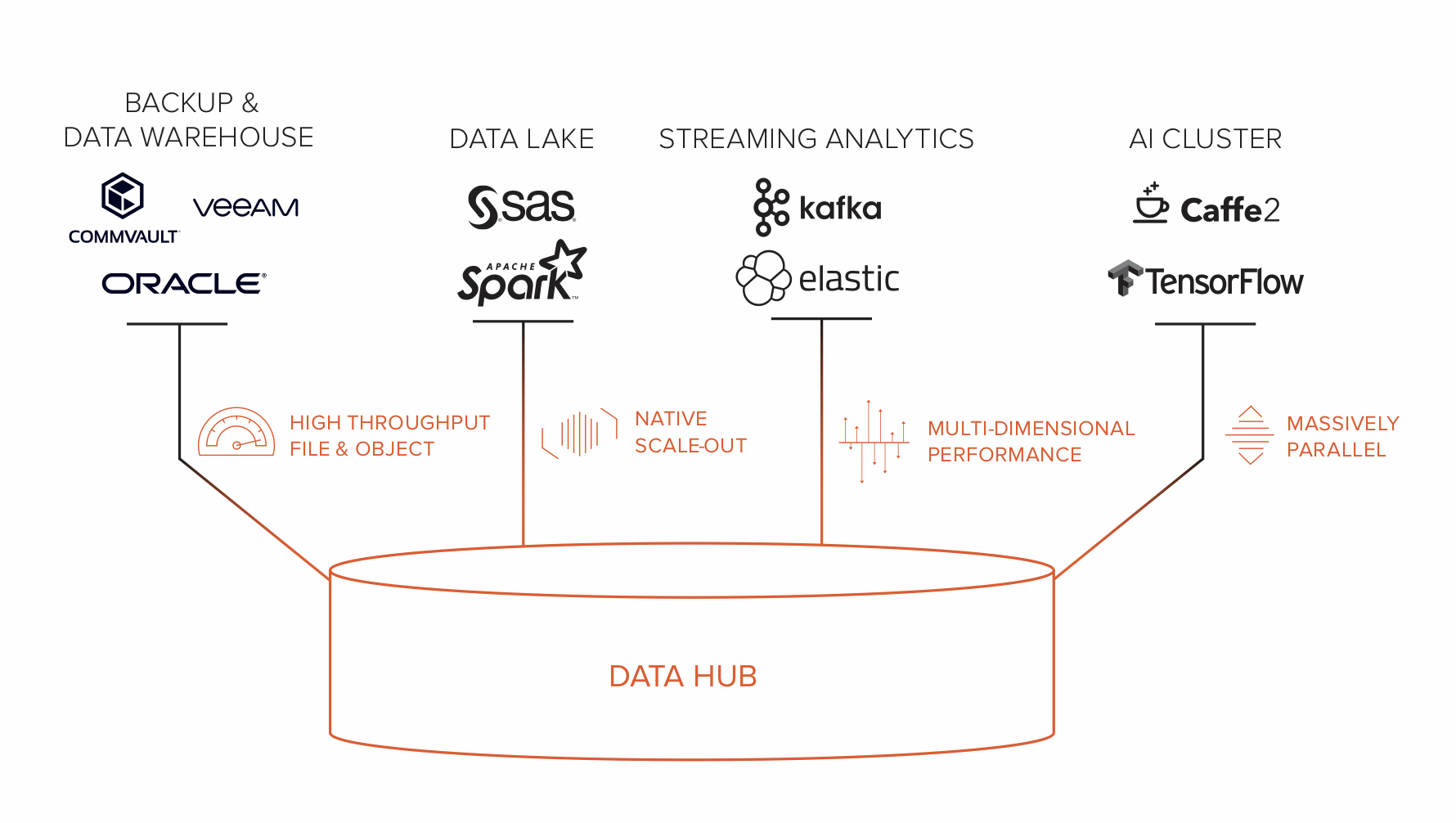

A data hub must have all four qualities. All are essential to unifying data. A data hub may have other features, like snapshots and replication, but if any of the four features are missing from a storage platform, it isn’t built for today’s challenges and tomorrow’s possibilities. For example, if a storage system delivers high throughput file and is natively scale-out, but needs another system with S3 object support for cloud-native workloads, then the unification of data is broken, and the velocity of data is crippled. It is not a data hub.

In this era, it’s better to share and deliver data than to lock it away in silos, and systems built to share data are fundamentally different than those built to store data. Now is the time for the storage industry — Pure included — to deliver a new and modern architecture. We look forward to the rest of the industry embracing this opportunity as well.

To learn more, please visit purestorage.com/datahub


Check out what others thought from our October 3rd CrowdChat.

Add to the discussion tweet using #unifydata


1 Deep Learning Scaling is Predictable, Empirically: https://arxiv.org/pdf/1712.00409.pdf
2 https://hbr.org/2016/11/what-artificial-intelligence-can-and-cant-do-right-now
3 Nuts and Bolts of Applying Deep Learning, https://www.youtube.com/watch?reload=9&v=5PrvLq6_xm8

지원하지 않는 브라우저입니다.

오래된 브라우저는 보안상 위험을 초래할 수 있습니다. 최상의 경험을 위해서는 다음과 같은 최신 브라우저로 업데이트하세요.

Personalize for Me
Steps Complete!
1
2
3
Personalize your Everpure experience
Select a challenge, or skip and build your own use case.
미래를 대비한 가상화 전략

모든 요구 사항에 맞는 스토리지 옵션.

모든 규모의 AI 프로젝트 지원

데이터 파이프라인, 교육 및 추론을 위한 고성능 스토리지

중요한 데이터 손실을 사전에 방지하세요.

비즈니스 리스크를 최소화하는 사이버 복원력 솔루션

클라우드 운영 비용 절감

Azure, AWS 및 프라이빗 클라우드를 위한 비용 효율적인 스토리지.

애플리케이션 및 데이터베이스 성능 가속화

로우 레이턴시 스토리지로 애플리케이션 성능을 극대화하세요.

데이터센터 전력 및 공간 사용량 절감

리소스 효율을 극대화하는 스토리지로 데이터센터 활용도를 최적화

Confirm your outcome priorities
Your scenario prioritizes the selected outcomes. You can modify or choose next to confirm.
Primary
Reduce My Storage Costs
Lower hardware and operational spend.
Primary
Strengthen Cyber Resilience
Detect, protect against, and recover from ransomware.
Primary
Simplify Governance and Compliance
Easy-to-use policy rules, settings, and templates.
Primary
Deliver Workflow Automation
Eliminate error-prone manual tasks.
Primary
Use Less Power and Space
Smaller footprint, lower power consumption.
Primary
Boost Performance and Scale
Predictability and low latency at any size.
What’s your role and industry?
We've inferred your role based on your scenario. Modify or confirm and select your industry.
Select your industry
Financial services
Government
Healthcare
Education
Telecommunications
Automotive
Hyperscaler
Electronic design automation
Retail
Service provider
Transportation
Which team are you on?
Technical leadership team
Defines the strategy and the decision making process
Infrastructure and Ops team
Manages IT infrastructure operations and the technical evaluations
Business leadership team
Responsible for achieving business outcomes
Security team
Owns the policies for security, incident management, and recovery
Application team
Owns the business applications and application SLAs
Describe your ideal environment
Tell us about your infrastructure and workload needs. We chose a few based on your scenario.
Select your preferred deployment
Hosted
Dedicated off-prem
On-prem
Your data center + edge
Public cloud
Public cloud only
Hybrid
Mix of on-prem and cloud
Select the workloads you need
Databases
Oracle, SQL Server, SAP HANA, open-source

Key benefits:

  • Instant, space-efficient snapshots

  • Near-zero-RPO protection and rapid restore

  • Consistent, low-latency performance


AI/ML and analytics
Training, inference, data lakes, HPC

Key benefits:

  • Predictable throughput for faster training and ingest

  • One data layer for pipelines from ingest to serve

  • Optimized GPU utilization and scale
Data protection and recovery
Backups, disaster recovery, and ransomware-safe restore

Key benefits:

  • Immutable snapshots and isolated recovery points

  • Clean, rapid restore with SafeMode™

  • Detection and policy-driven response


Containers and Kubernetes
Kubernetes, containers, microservices

Key benefits:

  • Reliable, persistent volumes for stateful apps

  • Fast, space-efficient clones for CI/CD

  • Multi-cloud portability and consistent ops
Cloud
AWS, Azure

Key benefits:

  • Consistent data services across clouds

  • Simple mobility for apps and datasets

  • Flexible, pay-as-you-use economics


Virtualization
VMs, vSphere, VCF, vSAN replacement

Key benefits:

  • Higher VM density with predictable latency

  • Non-disruptive, always-on upgrades

  • Fast ransomware recovery with SafeMode™


Data storage
Block, file, and object

Key benefits:

  • Consolidate workloads on one platform

  • Unified services, policy, and governance

  • Eliminate silos and redundant copies


What other vendors are you considering or using?
Thinking...
Your personalized, guided path
Get started with resources based on your selections.