Skip to Content
Dismiss
Innovation
Eine AIVision für alle

Eine einheitliche, automatisierte Grundlage für die Umwandlung von Daten in Intelligenz im großen Maßstab.

Erfahren Sie, wie das geht
Dismiss
16. bis 18. Juni, Las Vegas
Pure//Accelerate® 2026

Entdecken Sie, wie Sie den wahren Wert Ihrer Daten erschließen können.

Jetzt anmelden
Dismiss
Gartner® Magic Quadrant™-Bericht 2025
Beste Umsetzungsfähigkeit und beste Vision

Everpure wurde im Gartner® Magic Quadrant™ 2025 für Enterprise Storage-Plattformen als Leader genannt und als das Unternehmen mit der besten Umsetzungsfähigkeit und der besten Vision eingestuft.

Report downloaden

New Storage Architecture For The Era Of Modern Intelligence

Open Letter to the Storage Industry

September 12, 2018

Powered by analytics and AI, the era of modern intelligence has presented the storage industry with a unique opportunity. Data is the new currency and our opportunity is to be its steward. Yet historically we have actively held enterprises back from making progress with data. Legacy architectures, like data silos and data lakes, are built to lock data away, and can’t do the one thing required to realize data’s full value — share.

Data lake is dying. It was built on the obsolete premise that all unstructured data is meant to be stored. A new storage standard is needed in the post-data lake era. Modern intelligence requires an architecture designed not only to store data, but to share and deliver data. We call this new architecture a data hub.

The importance of putting data to work is easy to put into perspective. A recent study conducted by Baidu showed its dataset needed to increase by 10 million times in order to lower its language model’s error rate from 4.5 to 3.4 percent¹. That’s 10,000,000x more data for one percent of progress! A luminary in the field of AI, Professor Andrew Ng from Stanford University, noted “data, not software, is the defensible barrier (competitive edge) for many businesses”² and enterprises must “unify their data warehouses.”³

This emphatic call to unify data takes direct aim at the problem. Data is stuck in a complex sprawl of silos, and the storage industry is largely to blame for it. When an industry is so focused on developing technologies to store things, it naturally creates silos. But in today’s data-first world, silos are counter-productive. Data is out of reach from modern applications that can drive insights and innovation.

It’s time to rethink storage. A data hub is designed on first principles not only to store data, but to unify and deliver data. Unifying data means that the same data can be accessed by multiple applications at the same time with full data integrity. Delivering data means each application has the full performance of data access that it requires, at the speed of today’s business. Data hub shatters legacy infrastructure barriers where applications are given their own silos and replicated datasets.

Data hub is a data-centric architecture for storage that powers data analytics and AI. Its architecture is built on four foundational elements:

  • High throughput for file and object store
  • Native scale-out design
  • Multi-dimensional performance
  • Massively parallel architecture

There are four classes of silos in the world of modern analytics: data warehouse, data lake, streaming analytics, and AI clusters. A data warehouse requires massive throughput. Data lakes deliver scale-out architecture for storage. Streaming analytics go beyond batched jobs in a data lake, requiring storage to deliver multi-dimensional performance regardless of data size (small or large) or I/O type (random or sequential). And AI clusters, powered by tens of thousands of GPU cores, require storage to also be massively parallel, servicing thousands of clients and billions of objects without data bottleneck.

Then there is cloud. Applications are increasingly cloud-native, architected on the premise that infrastructure is disaggregated and storage is limitless. The de facto standard for cloud storage is object.

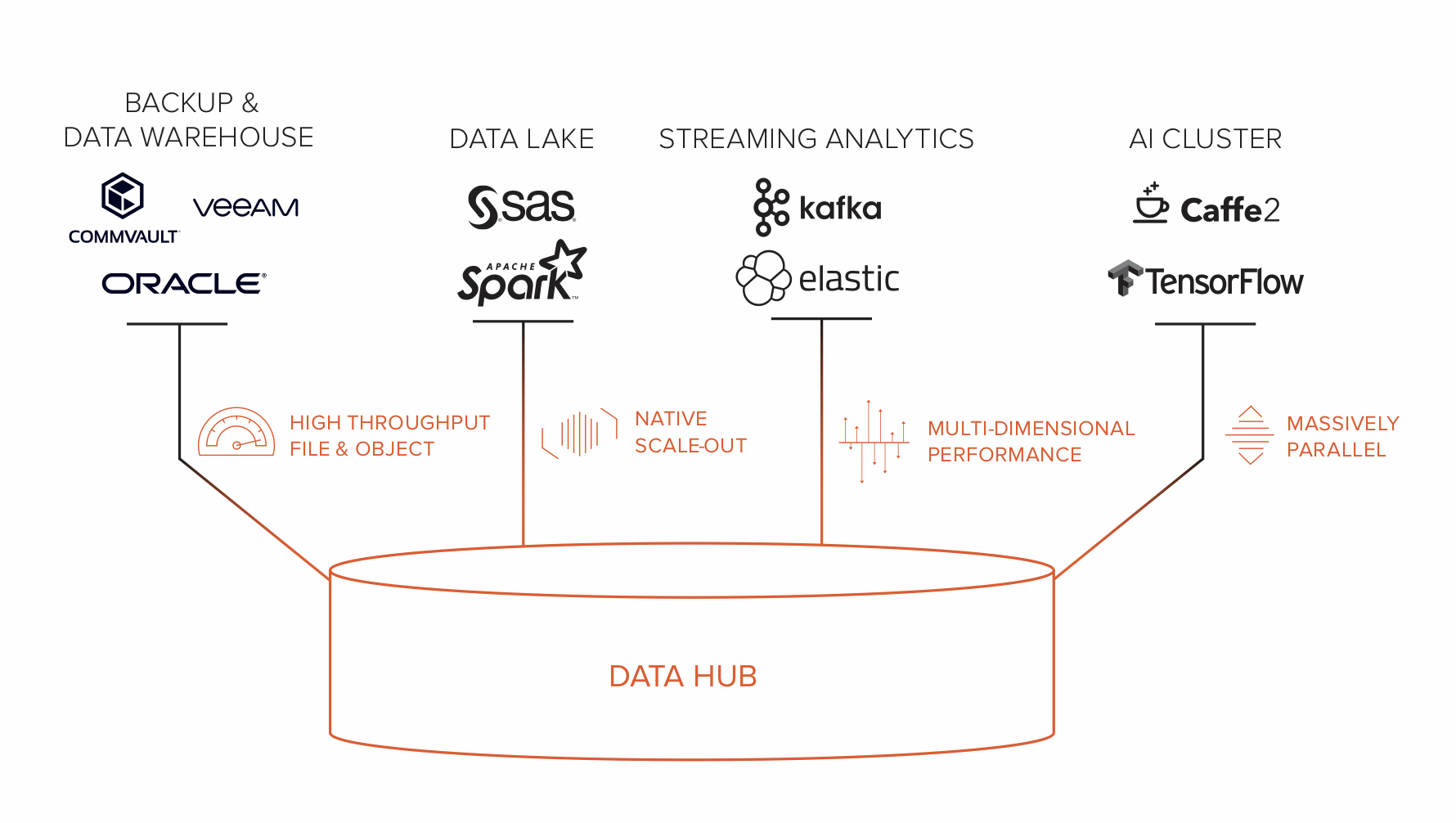

A data hub must have all four qualities. All are essential to unifying data. A data hub may have other features, like snapshots and replication, but if any of the four features are missing from a storage platform, it isn’t built for today’s challenges and tomorrow’s possibilities. For example, if a storage system delivers high throughput file and is natively scale-out, but needs another system with S3 object support for cloud-native workloads, then the unification of data is broken, and the velocity of data is crippled. It is not a data hub.

In this era, it’s better to share and deliver data than to lock it away in silos, and systems built to share data are fundamentally different than those built to store data. Now is the time for the storage industry — Pure included — to deliver a new and modern architecture. We look forward to the rest of the industry embracing this opportunity as well.

To learn more, please visit purestorage.com/datahub


Check out what others thought from our October 3rd CrowdChat.

Add to the discussion tweet using #unifydata


1 Deep Learning Scaling is Predictable, Empirically: https://arxiv.org/pdf/1712.00409.pdf
2 https://hbr.org/2016/11/what-artificial-intelligence-can-and-cant-do-right-now
3 Nuts and Bolts of Applying Deep Learning, https://www.youtube.com/watch?reload=9&v=5PrvLq6_xm8

Ihr Browser wird nicht mehr unterstützt!

Ältere Browser stellen häufig ein Sicherheitsrisiko dar. Um die bestmögliche Erfahrung bei der Nutzung unserer Website zu ermöglichen, führen Sie bitte ein Update auf einen dieser aktuellen Browser durch.

Personalize for Me
Steps Complete!
1
2
3
Personalize your Everpure experience
Select a challenge, or skip and build your own use case.
Zukunftssichere Virtualisierungsstrategien

Storage-Optionen für alle Ihre Anforderungen.

KIAIProjekte in beliebigem Umfang ermöglichen

Hochleistungs-Storage für Datenpipelines, Training und Inferenz.

Verhindern Sie Datenverluste

Cyber-Resilienz-Lösungen, die Ihr Risiko senken.

Senken Sie die Kosten für Cloud-Operationen

Kosteneffizienter Storage für Azure, AWS und Private Clouds.

Beschleunigen Sie die Performance von Anwendungen und Datenbanken

Storage mit geringer Latenz zur Beschleunigung der Anwendungs-Performance.

Verringern Sie den Stromverbrauch und den Platzbedarf von Rechenzentren

Ressourceneffizienter Storage zur Verbesserung der Rechenzentrumsauslastung.

Confirm your outcome priorities
Your scenario prioritizes the selected outcomes. You can modify or choose next to confirm.
Primary
Reduce My Storage Costs
Lower hardware and operational spend.
Primary
Strengthen Cyber Resilience
Detect, protect against, and recover from ransomware.
Primary
Simplify Governance and Compliance
Easy-to-use policy rules, settings, and templates.
Primary
Deliver Workflow Automation
Eliminate error-prone manual tasks.
Primary
Use Less Power and Space
Smaller footprint, lower power consumption.
Primary
Boost Performance and Scale
Predictability and low latency at any size.
What’s your role and industry?
We've inferred your role based on your scenario. Modify or confirm and select your industry.
Select your industry
Financial services
Government
Healthcare
Education
Telecommunications
Automotive
Hyperscaler
Electronic design automation
Retail
Service provider
Transportation
Which team are you on?
Technical leadership team
Defines the strategy and the decision making process
Infrastructure and Ops team
Manages IT infrastructure operations and the technical evaluations
Business leadership team
Responsible for achieving business outcomes
Security team
Owns the policies for security, incident management, and recovery
Application team
Owns the business applications and application SLAs
Describe your ideal environment
Tell us about your infrastructure and workload needs. We chose a few based on your scenario.
Select your preferred deployment
Hosted
Dedicated off-prem
On-prem
Your data center + edge
Public cloud
Public cloud only
Hybrid
Mix of on-prem and cloud
Select the workloads you need
Databases
Oracle, SQL Server, SAP HANA, open-source

Key benefits:

  • Instant, space-efficient snapshots

  • Near-zero-RPO protection and rapid restore

  • Consistent, low-latency performance


AI/ML and analytics
Training, inference, data lakes, HPC

Key benefits:

  • Predictable throughput for faster training and ingest

  • One data layer for pipelines from ingest to serve

  • Optimized GPU utilization and scale
Data protection and recovery
Backups, disaster recovery, and ransomware-safe restore

Key benefits:

  • Immutable snapshots and isolated recovery points

  • Clean, rapid restore with SafeMode™

  • Detection and policy-driven response


Containers and Kubernetes
Kubernetes, containers, microservices

Key benefits:

  • Reliable, persistent volumes for stateful apps

  • Fast, space-efficient clones for CI/CD

  • Multi-cloud portability and consistent ops
Cloud
AWS, Azure

Key benefits:

  • Consistent data services across clouds

  • Simple mobility for apps and datasets

  • Flexible, pay-as-you-use economics


Virtualization
VMs, vSphere, VCF, vSAN replacement

Key benefits:

  • Higher VM density with predictable latency

  • Non-disruptive, always-on upgrades

  • Fast ransomware recovery with SafeMode™


Data storage
Block, file, and object

Key benefits:

  • Consolidate workloads on one platform

  • Unified services, policy, and governance

  • Eliminate silos and redundant copies


What other vendors are you considering or using?
Thinking...
Your personalized, guided path
Get started with resources based on your selections.