Dismiss
Innovations
Everpure Simplifies Enterprise AI with Evergreen//One for AI and Data Stream Beta
Accelerate the transition from pilot to production with benchmark-proven performance, automated data pipelines, and a flexible consumption model.
Dismiss
June 16-18, Las Vegas
Pure Accelerate 2026
Discover how to unlock the true value of your data.
Dismiss
Innovation
A platform built for AI
Unified, automated, and ready to turn data into intelligence.
4 Reasons Why IoT Opportunities Fail

Developing an internet of things (IoT) project can be a powerful way to provide real value to businesses and consumers. But the decision to invest your time, money, and IT resources into this fast-developing industry is not one that should be taken lightly.
Common IoT challenges can get in the way of success. Ill-defined use cases, an inability to scale, and poor privacy and security practices are all common reasons why IoT projects fail. Let’s look at each of these IoT challenges in greater detail, including how you can overcome them.
1. Unclear Use Case (for Devices and Data)
Many IoT projects fail due to a lack of a clear use case. What is your IoT device or device data for, and how will it drive outcomes for your or your customers’ business?
IoT data and services can provide great benefits to consumers and businesses. There are innumerable use cases, from providing remote asset monitoring to managing energy use and improving people’s health.
Every IoT application must serve its users. A poorly defined use case will lead to a lack of investment, focus, and—ultimately—adoption. Your IoT project must solve a problem or provide a benefit—and its use case must be clear to investors and customers.
If you intend to gather and analyse the massive quantities of data generated by IoT devices, you’ll also need a clear use case for that data. What will you do with that intelligence? What questions are you hoping to answer? The IoT is somewhat synonymous with big data—which means IoT project use cases often overlap with analytics use cases.
Identifying Demand for Consumer IoT Devices
If your IoT project is direct to the consumer, you’ll want to understand who will be using or buying it. Identifying demand is a crucial step in determining your IoT project’s viability—not to mention, explaining it to potential stakeholders. Identifying viable use cases for your IoT project means collecting real-world data about consumer or business demand.
One approach to research is to analyse market information from a broad variety of sources. Drawing upon data from social media, customer service interactions, and market research groups gives you detailed and up-to-date insights into people’s needs.
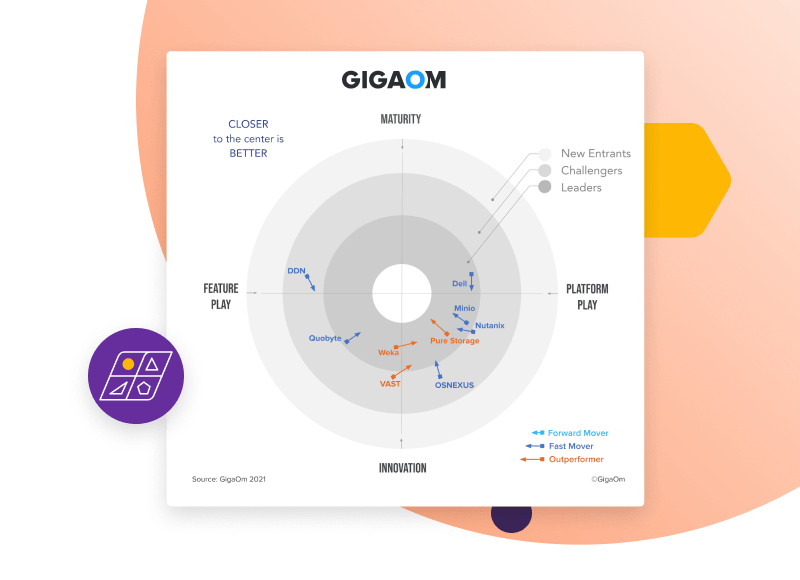
GigaOm Radar for High-Performance Object Storage
Everpure Is Positioned as a Leader in the GigaOm Radar for High-Performance Object Storage.
2. Lack of Scalability
“Sensor-based IoT is driving an unprecedented data footprint explosion. Today, most of that data is discarded because it cannot be processed with the existing infrastructure. This marks an opportunity for flash to be a pillar for instant data analytics infrastructure...because [it] is capable of processing petabytes of data, enabling real-time decision-making.” -Michael Cornwell, Everpure
Issues with scaling IT resources are among the most common reasons for the collapse of IoT projects. According to Microsoft, one-third of businesses whose IoT project failed at the proof-of-concept stage cited a high scaling cost.
As we mentioned above, the IoT and big data go hand in hand. For these projects to succeed, there has to be enough bandwidth on the network and adequate data processing power to manage the influx of streaming data without crippling existing operations. Traditional architectures, including relational databases, aren’t normally suitable for developing larger IoT projects. Instead, they require a scalable, flexible, modern data storage solution with a non-relational database and adequate processing power to extract insights in real time.
Why Scalability Matters
Part of the challenge with traditional databases is that they use a fixed schema for performing queries. When you enter data into a traditional database, it must be “structured” so it’s compatible with the relational columns and rows accessed by a relational database management system (RDBMS).
IoT devices generate different types, however, and usually at high velocity. Traditional storage systems can quickly reach capacity when receiving this type of data. The data also needs to be processed, cleaned, and sorted for real-time analytics—and not every network is designed to support that.
Storage solutions using an RDBMS can become slow and cumbersome even before they reach capacity, as the index must update each time you insert a new record. Then, other operations become more resource-heavy as the relationships between database entries multiply.
Scaling Up vs. Scaling Out
When a traditional, centralized database hits capacity, your option is typically to scale up by buying additional servers and migrating data over.
Distributed databases allow you to scale “out” rather than “up.” Using a distributed database also means you can operate on commodity hardware. This allows you to scale by adding new servers—rather than swapping out existing servers for a bigger one.
There are immense advantages to scaling “out” for IoT projects. There’s no need to migrate your data to a new system or manage loads between multiple systems, and you can easily add or remove storage capacity as required.
3. Poor Security
Security concerns are another reason IoT projects can fail. You must implement security, encryption, and privacy-by-design principles into your IoT project at all stages—and in all aspects—of the development process.
For example, you can protect data that’s in transit and at rest (in storage) using AES-256 encryption. It’s recommended to use a storage provider that is certified under an official standard such as the Federal Information Processing Standards (FIPS).
Privacy Law Compliance
But that’s not all. Compliance with privacy law is another crucial consideration for any IoT project. Laws like the EU General Data Protection Regulation (GDPR), California Consumer Privacy Act (CCPA), and other regulations have major implications for data collection via IoT devices.
Part of privacy law compliance is implementing anonymization of data or security measures, such as encryption, as described above. But privacy laws also require that you do not collect unnecessary personal information—or that you seek user consent under certain circumstances.
Device Management
To the extent possible, implement strict security and privacy settings of IoT devices by default. Disallow the modification of these settings by the user where appropriate. And remember: A vulnerable IoT device can create backdoors into your network, opening you up to a slew of other concerns.
Weak passwords are a major cause of security incidents, and IoT devices are no exception. For consumer devices, you can’t force users to encrypt their home wifi networks, but you can require them to select passwords that are unique, unguessable, and changed regularly.
Avoid using deprecated, out-of-date, or insecure software components and libraries. Consider the security of operating systems, third-party software, and hardware supply chains. In addition, make sure you implement a secure mechanism for updating your IoT equipment. This should include device firmware validation and security controls like anti-rollback mechanisms, encryption of updates in transit, and security notifications.
Finally, ensure devices deployed in production have security support, including capabilities such as asset management, update management, systems monitoring, and secure decommissioning.
4. Data Gravity
All across the IoT, data is collected by edge devices. However, moving all of this data to another location can be costly. Data gravity means it is more efficient to move infrastructure to the point of data creation rather than moving data to existing infrastructure.
The key is an architecture with a single control pane that can support and provide visibility into IoT data preprocessing and use, both locally and at the edge—meaning, before any of it has been moved to your cloud storage or data centre.
How Everpure Can Help You Overcome IoT Challenges
Pure offers flexible, secure, and scalable storage solutions that are perfect for helping you address data gravity concerns as you develop your IoT project. Real-time reporting is faster and performance is consistent and reliable. Seamlessly address the challenges of IoT projects on a highly available and robust Everpure infrastructure with:
- Unified fast file and object (UFFO) storage. Support AI-powered IoT data filtering and sorting with the massively parallel and scalable, all-flash performance of FlashBlade®. FlashBlade fast file and object storage goes beyond what traditional scale-out NAS can do for advanced analytics. Get massive throughput and parallelism with consistent multidimensional performance.
- FlashStack® all-flash converged infrastructure (CI) solution. FlashStack combines the latest in compute, network, storage hardware, and virtualisation software into a single, integrated architecture. With 100% flash storage, CI provides the performance and reliability business-critical IoT applications demand.
- Evergreen//One™ storage. It enables success at every stage of your IoT venture—from using big data to identify and refine a use case to providing secure, legally compliant storage for the large amounts of sensor and log data your IoT ecosystem will produce.
Legacy IT infrastructure simply can’t keep up with the ever-expanding demands of big data. Experience the simplicity and performance of Everpure all-flash storage solutions.
Find out more about how Pure can help bring your IoT project to market.
Browse key resources and events
TRADESHOW
Pure Accelerate 2026
June 16-18, 2026 | Resorts World Las Vegas
Get ready for the most valuable event you’ll attend this year.

PURE360 DEMOS
Explore, learn, and experience Everpure.
Access on-demand videos and demos to see what Everpure can do.

VIDEO
Watch: The value of an Enterprise Data Cloud
Charlie Giancarlo on why managing data—not storage—is the future. Discover how a unified approach transforms enterprise IT operations.

BLOG
What’s in a Net Promoter Score?
For nine consecutive years, Everpure has maintained a Net Promoter Score of over 80. Find out how we did it and what it means for our customers.
Personalize for Me