Dismiss
Innovations
Everpure Simplifies Enterprise AI with Evergreen//One for AI and Data Stream Beta
Accelerate the transition from pilot to production with benchmark-proven performance, automated data pipelines, and a flexible consumption model.
Dismiss
June 16-18, Las Vegas
Pure Accelerate 2026
Discover how to unlock the true value of your data.
Dismiss
Innovation
A platform built for AI
Unified, automated, and ready to turn data into intelligence.
42:30 Webinar
The Future Belongs to the Resilient
Explore how Everpure and Commvault’s co-engineered solutions are transforming cyber resilience and data protection.
This webinar first aired on June 18, 2025
The first 5 minute(s) of our recorded Webinars are open; however, if you are enjoying them, we’ll ask for a little information to finish watching.
Click to View Transcript
Thank you everyone for joining us today. Um, my name is Cyrushana. I'm a solution director, uh, at CommVault, um, managing the Pure Alliance globally, and, uh, I'm here with Satch. Yeah, my name is Satch Nanda. Um, they call me a technical manager for Alliance technical Manager.
I'm basically an alliance's SE, so technologist side. Great. Um, so, uh, if we move forward, uh, yeah, and we've gone through the introduction. So, um, I know you guys are fully aware of this, right? Um, you know, the world's changed, um, it's not a matter of if it's a matter of when a cyberattack's gonna
hit your organization or your customer's organization, right? And I mean, the stats are up there, right? Uh, look, ultimately, hackers hitting environments, they want to go after your backup enterprise, they do not want you to recover, right? We all are aware of that. And you know, um, they are now utilizing the same AI that our kids are using to try and
cheat in school now they're making better ransomware, right? And uh it's getting smarter, it's more effective and, um, you know, like I said, it, it's, it's gonna hit your organization. So what Satch and I would like to go through today is how are CommVault and Pure helping organizations globally around um cyber resilience, right?
And um if you next slide. Uh, look, the stats are here, right? Um, typically it's an average of 24 days to recover from a ransomware attack. Um, that boils down to $140 a minute and typically 4.8 million, 4.9 million as an average data breach cost, right?
Um, you know, anything you wanna add, yeah, just a couple of things not on the slide, but. Um, here, I turned on turned on. All right, so a couple of things. Uh, so I believe that number for the $4.8 million is for global numbers. In America it's actually higher. I believe we're a little over $5 million per
breach, uh, and in the previous slide, Cyrus talking about AI, uh, AI is very difficult for our industry, right? So they're using AI to break in and it's difficult for humans to react, right? Humans have fatigue, humans are slow to respond. Um, we'll barely talk about it today, but Comvault has AI embedded in our product,
a couple of different ways, uh, to understand zero day threats, understand those signatures, uh, but also AI to help you compose, uh, A AI to ask you or help you troubleshoot. So there's a couple different ways that we have AI that's built into our product. Um, All right, minimum viability or the minimum viability company?
People familiar with that concept? Do we know what that is? No, no head nods. All right, a few people know. All right, so. This is what's on the quiz later, but what What I think it is, uh, digitally speaking, it's the data. That makes you, you as a company.
It's people call the crown jewels, uh, breadwinning apps and data, all the stuff you need. To recover to be you as a company, and that's not a. To necessarily do everything I have Jimmy's HR app, you know, recovered. You don't need that, but maybe some very
important databases, very important VMs and, uh, physicals, possibly some databases. Getting that back quickly is what we're all about, right? We're all about trying to minimize that downtime. Those numbers and mileage always varies with those numbers and what it costs per minute, but what we do know is it's very, very expensive and very,
very embarrassing for businesses, uh, they get hit. Uh, so for convolts. We'll just tell you, like our minimum viable company is basically. Uh, an 11 terabyte database, a smattering of VMs, some physical servers, uh, and of course active directory.
So part of, uh, Cyrus's number in a previous slide is like 99%, uh, hit the security and the data protection, right, but 90% of that is actually Active Directory. So, uh, for you and your customers that might not be backing up Active Directory or not doing it correctly because backing up the VM that might be running AD.
And recovering that might not be good enough, most likely is not good enough to recover AD. So whether you have Convault or Pure, um, these are the steps that we've identified as extremely important to recover, you are a minimum viability company. So first of all, air gapping, making sure not just your indexes, but that your data is indelible, right? So what good is having your index frozen if.
Somebody logs in and, and breaks into say pure storage and deletes your data, right? It's, you got great indexes, but you have no data to recover from. Very important, uh, ability to identify last known good recovery points. So we're in Las Vegas. I remember two Septembers ago MGM.
Got hit Caesars got hit, so the issue wasn't that they had no backups. They had actually good backups that they thought the question they didn't know if they were clean, right? So what they had to do was actually build an on-prem isolated recovery environment or clean room on the fly. That's the last time you want to be learning how to do these things.
That's why it took 40+ days to recover this data. They had the backups. They just didn't wanna. Recover 99% of that data and then when you're on the one yard line reinfect your organization with bad data and so that's why they had to use clean room or isolated recovery environment, uh, and then, uh, forensics, so people, I'm do people here have cyber insurance?
Any of that stuff? OK. Same guy for everything. All right, so you understand it all. So, right, all good. So. I mean, very important to understand like how's it getting in and is it clean, right? Are you doing all the right things to recover
your data? And then for us, so I mentioned what we have at Commvault. So when we, when we got rid of our spinning disk for our backup target. Uh, and we got pure storage. We have, we have pure storage flash blades, uh, for our minimum viable company, right? Well, I mean,
what do we used to have? We used to have tape, right? guessing with the gray and the no hairs like and me, uh, we all remember tape, right? tape was good for a lot of things, uh. But it was flimsy, right, it was portable, which was great. One thing it was really not good at doing was
doing massively parallelized recoveries, right? And in the old days when we had to do recoveries, right, they were very operational. It's like, oh crap, I deleted this file. Can somebody help me? All right, within an hour or two, your guy is gonna get you your tape back and, and you can recover your data. Then we had DR recoveries.
But now we're seeing cyber recoveries, very, very difficult to do and oftentimes it's very, very pervasive in your organization. You might need to recover 100, maybe 1000 machines at a time. So doing like the old purpose built. Data protection appliance doesn't work because it was spinning disk,
right? That data looks like randomized data. It's very difficult to write when you have contention and noisy neighbors when you're recovering from, from spinning disk. So. We found acomvault that Object on Flash was the quickest way for us to recover our data and We compressed that by the way, that 12 terabyte database, excuse me,
11 terabyte database was taking over 12 hours to recover. We compress that down to just over an hour. So our recovery for our minimum viable company is measured in hours, like just a couple of hours, uh, so what that does for us, it allows us to test. We can play war games like every week we can
play war games, we can mimic an attack on our most valuable stuff, right? Our minimum viable company. Recovering AD, recovering that database, and oftentimes we're doing it. By not even recovering the data we're actually doing live mounts, right? So we're mounting snaps in some cases we're
just because it's running on flash, we're actually recovering from the backup itself, right? So all of this compresses the downtime right to hours, not 24 days, which is ridiculous. So why Pure and why did we go to Pure so. It's pretty obvious. So I sold my first Pure array in 2016 when I
was, I was a CTO for a reseller in Chicago, and Pure just made so much sense. There's no spinning disk, no hybrids. It's all flash all the time, extremely fast, very important. And I talked about running from Snaps, right? We also integrate with Pure, very, very integrated with Pure, uh, with IntelliSnap and then storage accelerator which
allows us to bypass some of the infrastructure so you can write directly from the client to the pure target, right? That saves time, reuses payloads, uh, very, very smart. Scale, I'm gonna go clockwise, so scale. That means a couple of things to me in regards to pure,
right? So you know, we, we're all the session today, so they've got a 75 terabyte DFMs. They now have the 150 terabyte DFMs, so with the 75s you can get 24 petabytes and 42AC units in one array. Pretty good, right? But with the 150s, that's double it 48,
and Charlie just said we're getting the 300s this year at the end of this year. That's, that's 96 petabytes of capacity. In one rack, right, so there, that's, that's one point of scale. The other point of scale is what I mentioned earlier is when we're recovering these days, we have to recover many, many things at once. So pure,
so object on Flash allows us to do that. We could not do that with, with Maz we have NFS client limitations, right? 100, maybe 200 NS client maxes don't have that with Flash. Recover 1000 machines at once, right? Very, very helpful, you know, in the enterprise space. Security, we all care about security.
Uh, I mentioned it earlier, right? We want to lock down our indexes. We also want to lock down the data. We have to have both to recover our data. And then simplicity. So simplicity essentially has been the hallmark from Pure ever since I first heard about these guys over 10 years ago,
right? So, You know, we've been able to we were able to manage for the first time. You know, some of these arrays with our phones, right? Very, very simple, uh, from a guy who was a former Hitachi. Uh, storage admin, I mean, vastly different. I don't wanna bust on Hitachi either.
They, their stuff works with our stuff fairly well too. Um, but the simplicity, it's hard to beat, uh, pure, and I believe. As comprehensive as CommVault is. I believe the fact that we can be. We can say yes to so many different workloads, right?
That gives us the power of one application, one data protection application, so that simplifies your your enterprise as well. Uh, IDC told us, uh, that if you have two or more data protection applications, you're 38% less likely to meet your SLAs when you do a recovery. So simplifying is really important for your organization.
So Back in November of 2023, um, CommVolt made what we call the shift. We went from being a backup company to not cyber resilience company and people when they think of CommVault, hey, we're close to being a 30 year old company and oh that's legacy, but we've totally changed and.
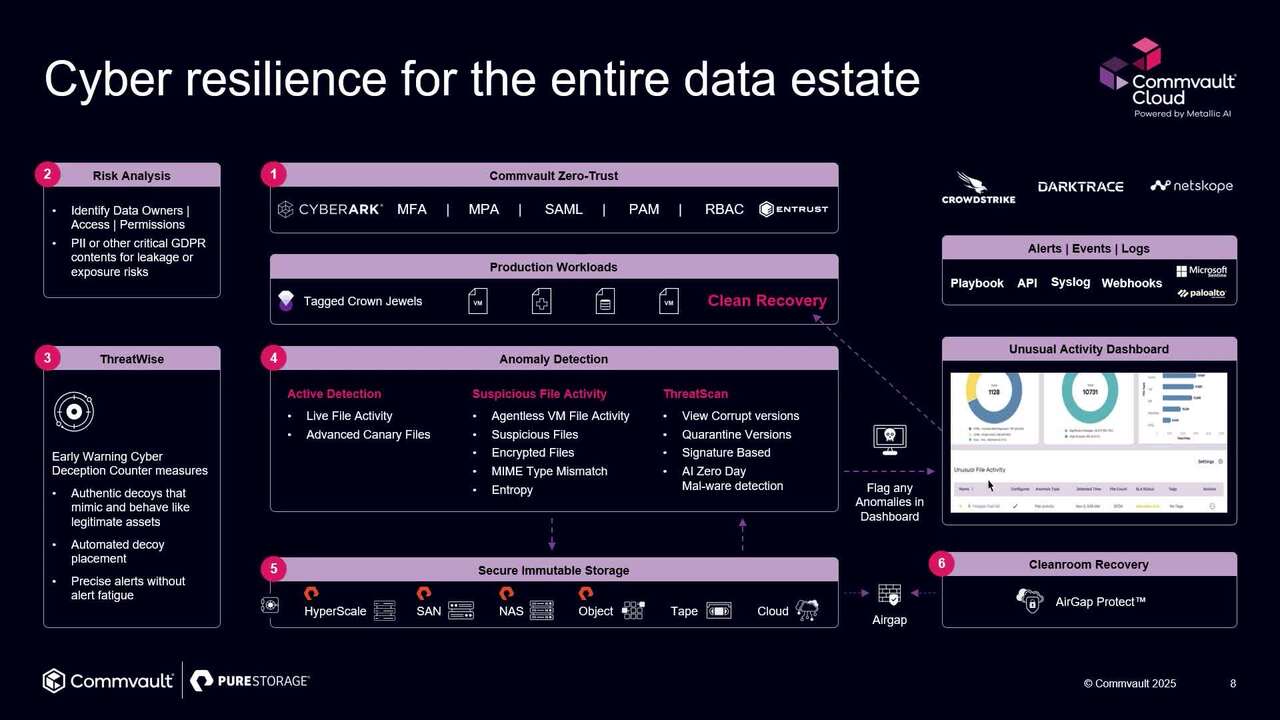
Um, redesigned our portfolio and making the Convolt cloud portfolio. And what I want to run through is what is the Convolt cloud sweep? And we all know that in your organization, you're gonna have production workloads from VMs to files to databases, protecting cloud even. So that's what you see up there. So we move to the next phase. What we've done is we've incorporated that zero
trust architecture into our product portfolio, right? So there's multi-factor authentication, multi-person authentication. Um, we have now joined with the uh the security companies, the software you're running in your environment on SEM and so, importing those into our product, right? We're bringing security into the backup
enterprise, right? Um, next, so. What I'm wanna go through is how Commvault cloud protects an organization from pre all the way to the end, OK? And what you see here is risk analysis. We've had this for quite some time.
Risk analysis, uh, we even have uh PS offerings through our organization where we sit down with the customer and figure out what is your recovery tier structure of your clients in your organization. This helps clients prioritize for disaster recovery, but most importantly cyber recovery. Another benefit also is helping organizations and helping.
Companies like Pure to um with their customers, when you have all that data, you can now prioritize the types of data you have in your environment and if there's new arrays that are gonna be brought in, hey, this is, let's say tier 2, tier 3 data now, let's move that to the older arrays and bring our tier 0, tier 1, you know, clients into the newer arrays. So you could,
it has multi-use cases with risk analysis in an environment. Um, now, as I said, I wanna show a complete story from pre to post. We have something called threat wise. These are sensors that you can deploy in, in your environment, and as long as you have a webOY login, you can emulate that.
In an environment so from network switches to storage to your backup media agents and commserves, you're mimicking that and you're trying to see proactively if you are getting hit from the outside from any sort of hackers or intrusion. So that's on the preside with threat wise. If we go on Anomaly detection that's been built into our product for quite some time.
We use ML in our product and AI. And what it does is actively scanning your backups and looking to see were there any anomalies from the workload that happened, you know, yesterday or previously, giving you a better picture of what's going on in your environment so you can be proactive. Hey, you might wanna take a look at this um this client that you backed up because there's
a lot more workload on it today than it was yesterday. Maybe there's some encryption going on, right? Looking into things. I'm gonna get back tore scan later. But let's just move on for a second and show you, OK, where's pure fit in?
Around secure immutable storage. Satch talked about that earlier, right? Pure is a perfect fit. With their their block, their NAS, and their object storage, especially for a back end for a comvault, having that immutability safe mode with snapshots, safe mode also on the object storage protecting the bucket level,
right, as Satcher was saying earlier, immutability on the storage layer that works in conjunction with comvolt on more, more granular right object level with exactly. And, and, and on the left there you'll see hyperscale. We just introduced a new offering. Beginning of the week We brought hyperscale platform onto um
pure as a back end with hyperscale flex. OK. There's some, I'm very excited about this because now it is our hyperscale X platform was hyperconverged servers where um you would start with 3 nodes and grow a node at a time and it's all internal disk. It is a hardened OS with SC Linux, um, but when you needed to upgrade,
you had to upgrade the, the server with all the compute and the capacity too. With the hyperscale flex offering with Pure on the back end, now it's disaggregated. If you need more compute, you can add compute. If you want more capacity, you can add it separately, all while taking advantage of the hyperscale OS and the
hardened uh SC Linux that we have on the servers, creating a, a fully air gapped appliance approach. Now, with pure flash blade on the back end. OK. Some really exciting things are happening too by end of year. Um, you're gonna see something next that I'll, if you want to hit next.
Um, We have something right now that's cloud-based with Airap Protect and Cleanroom recovery. Air Gap Protect is a domain within Azure that's Commvault, um, clients purchase based on front end terabyte licensing, and you're making your either your 2nd or your 3rd copy in Airap Protect. The, what you also have the ability to do with Airap Protect is also send copies of your
commserve. So now you can fully with Now clean room recovery, which is what we have right now, bring up your environment with your com serves, your data's there, recover it, do all your, let's say testing if you needed to, or actual recovery from a cyber event. And the, the great thing with clean room recovery right now is once you're done with it,
you bring it down and it doesn't exist anymore, right? Protecting you from future hacking attacks, right? Almost more importantly though, it didn't exist before. That's right, so there's nothing for them to log into. That's, that's very corrupt. So, um, the, the added benefits of this also is
that you own your data with CommVault with AGP. And no egress fees to get your data back. So, um, there is feature functionality, especially like going to AGP around. Um, elasticity with compute and capacity, but we're gonna bring the same feature functionality now by end of year with on-prem clean room,
and that fits perfectly with this hyperscale platform because as I said earlier with hyperscale, it is a hardened appliance, we control the OS we have the air gapping technology and we can bring that same feature functionality I just went through now on prem. So there are customers, there are industries, there are even countries that don't allow you to go to the cloud. That's what on-prem Cleanroom is gonna allow
you to do, especially with a hyperscale platform and especially with hyperscale flex with Pure. Um, if, let's go one more. Now, I talked about earlier, I wanted to get back to Tread skin. Thread scan is another feature functionality where we have antivirus scans of your backups, ensuring a clean copy will be restored.
OK, um, what this does, and as Satch said earlier, when you're down on the, the one yard line, you wanna reinfect your environment. Um, I have a future slide what we're gonna show you what we're doing with air gapped IREs as well. But ultimately, you wanna run threat scan your environment to scan what you have within your, your backup enterprise and sure if there is any
sort of uh corruption or anomalies, that will be it, the threat scan servers are tied to the com serve. So when it comes time for a, a cyber recovery where you're just going for your last known good, the comer knows not to recover those files that are corrupted. And ultimately what you'll see also is that thread scan is being used within uh IREs to
ensure another scan is taken so you don't infect that IRA like like Satch was saying before. So um that ensures the clean recovery and one thing you don't see here also is we have another thing. It's called cloud rewind, which Satch is gonna touch on afterwards. Just keep that in your, uh, you know, for future slide that we have here.
But just showing the complete story. around CommVault cloud portfolio and how from beginning all the way to the end of recovering your data and then ultimately rebuilding your data about what CommVault is doing and how we redesign and how we separate ourselves from the competition. Especially around one thing I wanted to emphasize, all the stuff that we've gone
through, what differentiates us from the competition is a single UI to manage everything. You're not logging into something else to, to, to take care of thread scan, you're not logging into something else to, to monitor uh any other feature function. It's all within one UI. Can I just add on to that slide, but so that's basically meat and potatoes.
A lot of that, you know, meat and potatoes of combat, but so kind of boring, right? There's some complexity in there, uh, but what that would have meant to MGM, so. September of 2023 MGM was a $15 billion market cap company, right? By October it was an $11 billion market cap
company. If they had something like this, they had pieces of this, they just didn't have all of this. If they had this, you know, we would have recovered that in hours, maybe a day or two, right? Not 40+ days to recover, so. That's the, that's the business aspect of this,
right? That he talked about the technical aspect. Business wise, it's about minimizing downtime. That's our whole talk is basically about that. So I, I'll take this one, So If you follow Gardner, you know, we've been the top right of the top right quadrant pretty much for the last 13 years. Pure has been for the last 11 years, and I, so Cyrus and one of the fellows in the back,
Rick and I, we do a lot of the, uh, SE boot camps for Pure. We get them up to speed on why Cabot plus Pure makes so much sense. And one of the kids, one of the junior SEs is like, do you really flexed on us, you know, you're 13 years, uh, gardener leader, we're only 11. I'm like, yeah, but we've been around since 1996.
You guys started in 2008, so we, you guys sucked for less long than we sucked, right? So you've been more relevant quicker um than we did. So. Like I said, 13 years. So but think about this. So about 5, 5ish years ago we redesigned our indexing, we redesigned our
product really, um, we were already a leader, but it's, it was like Tiger Woods, right? He was already number one in the world and he changed his swing like, well why are we doing that? Because you wanna be relevant in the future. That's what we did. With combat, so we decided, we decided to make our products more modular,
so we don't really care what the storage is. We don't care what the protocol is, you know, we can sometimes like in some of our locations, right, we can block up, excuse me, back up pure on file or block replicate that to object, right? Don't care. It doesn't matter to us, it's, it's so modular, um.
They throw a more icon in there, so. I was born in the 60s, but I grew up in the 70s and 80s, and I grew up in Iowa and not a lot of people looked like me um in Iowa. And so. Iowa people are like 99% good but you meet over 100 people a day as a kid.
Uh, so it made sense. My parents like, we should get you some, uh, martial arts training. So I started doing martial arts training, uh, when I was pretty young, and, uh, which worked out great for me, but I fell in love with Bruce Lee. You guys know who Bruce Lee is here, so. Does anybody know his water speech?
Anybody here know that speech? I thought it was beautiful. I loved it. So one of the main reasons I love Cobalt is because we're like water. So Bruce Lee said, uh, to an interviewer, you wanna be like water, right? Water is formless and shapeless.
You put it in a teacup, it becomes a teacup. You put it in a glass, the water becomes the glass. You put it, uh, in a teapot it becomes a teapot, formless shapeless water can flow. Or water can crash be water, my friend, right? That is what Comvault is, right?
Some of our competitors and even we do this, right? We can be put in a box. I'm not gonna name them, but people sell their product and they come in boxes and that's all they're ever gonna be. For us, you could land us on an elite storage array or blade like pure,
and we're gonna kick butt, right? If you want to put us on something that is past its maintenance window and you wanna put it. On something that you just pay time and materials for and just make it cheap, we can do that we don't care, uh, so it does not matter what you put us on. We just wanna add one thing real quick before we move on.
Uh, the why why we have this separated into different planes also is what helps us as the title says, we can help you meet today's regulations. Previous ones as well as any future regulations that are out there, and I'll go into a design that we've done around some sort of future regulation that is out right now. Um, if we, yep.
So, um, Satch mentioned earlier active directory protection. This is a new feature function that we have. Look, uh, real quick summary on this one, cyberattacks, 9 out of 10 of them are hitting your active directory. We have the capability of protecting your active directory and recovering the whole forest, um,
you know, easily for customers. It's a, it's a great thing to um. Revisit your existing customer base, going in there, ensuring that, hey, they are aware that, you know, we have something now that can help complete that cyber resilient solution, um, yeah. So cloud rewind, so Confault doesn't really buy a lot of products,
but this is one that we did do. We did buy A Paranics very recently, like just over a year ago or so, uh, and we renamed it Cloud Rewind, and that's essentially what it allows you to do. So many people back up their data in the cloud and they're just backing up their data. They're not necessarily backing up their infrastructure and if anybody has a lot of
objects in the cloud, you know, some of our customers might make 10,000 object changes in the cloud. I mean, good luck recovering to what you don't know exists. What if you have 150 net scalers and 75 databases, right? You need to know how to recover that first. The infrastructure needs to be there first before you could recover that data onto it.
So what cloud rewind does, much like a policy, uh, it will, uh, intermittently go out and Pull and discover the objects that exist in your, in your cloud. So what we're able to do, and we're able to demo this a few months ago, is, uh, if you're in AWS East. And you want to recover in AWS West, well, that's pretty difficult if you only backed up
the data. You want to recover all the infrastructure first so we can actually recover from. An east region to a west region recovering the infrastructure first and the data on top of that in a very automated and orchestrated fashion to make it very, very quick and very, very complete. I think in summary also just want to say we've
we've shown that we can help protect your data recover your data from but now we're also helping you rebuild that data. That's, that's what cloud rewind does helping you quick quicker up and running from a cyber event. Yeah, it's different from just recovering data. This is recovering applications, right? It's recovering your business.
That's, it's. This is not table stakes, right? A lot of the companies will just recover your data. This goes far beyond that. We have been working in conjunction with Pure. And another AI's partner, Kendall on a solution which was an air
gapped cyber resilient IRA. Um, I had the privilege of working on this. Um, it was based on Dora, which is a regulation that the EU introduced for the financial and banking industry in the EU, but it affects banks here that do business in the EU, right? And essentially what it was designed around is
the meeting the articles of Dora around recovery. Um, and ensuring that payment systems, ATMs, they're up within 2 hours. You're not doing that on Spainning disk, you're doing that with Pure and you're doing that with Convolt. That's what Kindall had partnered with us, um, and what I wanna just go through real quick is what is the offering around this air gapped
IRA. So at the very top above layer one, that's the customer's production environment. They're doing maybe between multiple sites, they're, they're active active backups replicating it. But now where you have the air gapped IRE that comes into play, that's, that's from layer one on.
So within there you have a air gap scheduler. And the air gap scheduler works with our Convault media agents. They can open and close ports and you have a one-way pull. That is being done to replicate the data into this first zone of layer one. OK. Um, again, stressing that because it's an IRE
extra precautions are made because of hacking attempts and ensuring that, you know, it is a fully immutable IRE air gap solution. What you then do is you go down into layer 2, and this is where you will have your commserve, your DR comer and media agents and flash blades. Where, um, the backup will be recovered to.
Now I forgot to mention that in the production zone you have threat scan running. Cause you wanna scan your data. In production and you wanna make sure hey has anything been corrupted before I replicate it so now the DR comer knows about hey this was scanned already it's clean, let's focus on the stuff that wasn't scanned so they're extra threat scan servers now they
reside in this zone. And within the zone, you're doing your threat scan and you're preparing yourself to rebuild your environment, which goes into layer 3, which is that IRE. OK, um, that's where you're gonna recover your data. That's where customers have the ability if they want and um to either recover their
data, continue production because maybe production is shut down because of forensic analysis, they can't access the stuff. This is all stuff that customers work with Kindle on to figure out what, what levels do they want to purchase and have managed for them. But I want to also emphasize that you have this layer of 4.
That's where, so all this is happening on a, a network? Air gapped with backups, but you also want to take advantage of your flash ray snapshots and immutable snapshots, which you can, which you will be taking with Convolt with IntelSnap, but you could take snapshots on their ray level, replicate that in production that gets copied by a dark fiber down to your IRA.
And you have the ability for those tier 0, tier 1 clients, hey, let's recover from snapshots first for that quicker recovery. Again, those ATMs in this example. Or payment systems, quicker recovery. So, um, a complete story can be told with. Pure and convolt around our technologies
ensuring a fully air gap solution, which is why organizations like Kindle. I chose our two organizations to offer this within the EU for their customers. Um, if anyone wants to find out more about this, um, Chris is in the audience we're more than happy from Pure with Mike Russo back there who runs the FSI group for Pure. Um, we could talk more but this is not, this is designed around Dora,
but Pure Commvault, Kindle, we're offering to all our customer base because at the end of the day every industry needs an air gap cyber. Recovery environment, right? And what we designed this for. was around Dora, but it can be replicated in any industry.
Um, and I touched on it earlier, but I hope you're seeing there's pieces of puzzle that are now starting to be created to create a complete story. Hyperscale flex will fit perfectly in this. The hyperscale flex appliance has that air gapping that will be. A, uh, the, the work with the air gapping with this and your air gap schedule to,
to have that complete fully cyber resilient solution. Um, and next, yeah, awesome, real quick though, uh, one thing we didn't talk about with Dora, uh, which went live this January, by the way, uh, very, very strict requirements, and it really affects the financial industries so the banking, the, uh, insurance companies, the, the trading houses, like people that have our money in
Europe, um, but there's a requirement in there to get back essentially your MBC, your crown jewels in 2 hours, which is why the industry turned to pure and combo. And we've tested it, it's working, it's getting done. And by the way, if you're not compliant, there's actually jail time uh for this, right, which is another reason why people pointed to the Covat and uh and Pure working
with Kendall, so, uh, very, very strict in Europe, yeah. The question, it sounds like this is software as a service over at the EU. Is there any reason you don't want adopt it here that we can, that my clients can't run it for themselves? Oh absolutely it's just, it's just it it it it all depends on the customer if they have the
infrastructure also to bring something like this up, uh, um, yeah, it could be done within customer sites. It'll be easier to be done with, can you go to the next slide with a hyperscale flex platform too with the customer being an on-prem, that's the on-prem clean room. Recovery approach automating before where I was showing with all those layers is very manual
process right now for for recovery cleaner on prem cleaner will help with automating that recovery. This hyperscale flex because I know we're limited with time here hyperscale flex again we just introduced it this week. um, I invite you to after this please meet with myself and Satch. And Brian Clark, who's standing back there, he is the PM for IntelliSnap as well as our
hyperscale platform. Uh, he worked very hard with Pure to get this out. Um, we have it in early adopter mode right now, but what you get is, um, instead of a hyper converged platform, you have, um, you know, disaggregated nodes running where you can.
If you need to in, um, you know, add more compute you can with flex nodes or you can add more capacity on the back end with Flash Blade, but what it is is a fully immutable, um, because it's object storage you can, you know, uh, have wormlock enabled so it's a fully immutable appliance, uh, and bringing that whole appliance approach that Convolt offers with our hyperscale OS and
hardening into your backup enterprise for on-prem. Not to mention support and yeah, and fully supported by combo. Yeah, so one throws a choke on that. OK, now this looks ugly, but this is kind of the beauty of Combo. I mentioned earlier that we are the most comprehensive platform on the planet,
right? I'm not gonna break all of these things down, but so many of these things are intrinsic to your organization from, from Active Directories to your databases, uh, to your VMs, uh, and then so much more, um, and 365, a lot of our users use that very, very important. So we have.
Kind of what you see on prem we have in the cloud in our as a service or SAS offering so all the same look and feel, it looks like it's just the same interface one product, uh, everywhere in the organization so extremely comprehensive and uh this I would say is a differentiator between us and every other product that exists from endpoints to databases to cloud and we have the full protection. Um, one thing just wanna highlight security IQ
we have that built in where I, I, I like to. Emphasize that backup admins are now closer to security admins in an organization. There's a security posture sport and through, um, AI and ML within our product, it's alerting you of certain features functionality that you can maybe improve to increase your security posture score, all things that you can do the backup admin,
maybe have conversation with security admin, uh, bringing both organizations much more closer together. Yeah, and let me touch on threat wise do people, I mean, you ever seen it work or use it anybody here? Uh, OK, so I'll, I'll explain it really quickly. So what it really is, um, he mentions the term sensors, that's what it really is,
it's like lightweight sensors that you essentially spread out around the perimeter of your network in your organization and you're fooling people into thinking that it's a high value asset. So the bad actors are coming in possibly hitting a threat wise sensor. They think they're getting information about you.
We're getting information about them, the bad actors, and we're sending that info, as he said back to your seams and your source, uh, and oftentimes, and I'll, I'll reference the state of the state of Colorado, um, so we partner with the state of Colorado and we had anomaly detection, not threatwise we had anomaly detection of the state of Colorado and one of their directories.
Uh, I think got hit 19 times in about an hour and it normally got touched like twice a day, so we flagged that as anomalous and because we had orchestration, uh, an automated recovery built in, we were able to fence off that part of the network that was being attacked. Uh, we limited the blast radius, what we, what we call the blast radius to just two machines,
but just imagine. If that would have proliferated, ah, that's a hard one. If that would have proliferated, spread, if that would have spread, uh, to the rest of the organization, you know, that quickly, uh, a lot of damage can be done.
So we're very proud of threat wise. I, I don't think there's anybody else on the market that has something like this, so, uh, very, very impressive stuff. And what we'll find on that note is, uh, if cus if our competition doesn't have it, they're quick to copy us too, usually we're 1st 10 like clean room. We're the first to offer that.
Um, so you'll see it now offered with other, uh, competition. So we got like 1400 patents, so we're typically thought leaders just about every space, right? We're first to the cloud, we're the first to offer, uh, dynamic, um, cloud bursting, right? So if you need to do a quick recovery, you can add more compute resources to your recovery, uh,
scale it down if you don't need it. Why pay for all those VMs if you don't really need it so we can help you with that. So our typically our we don't talk about it here, we haven't talked about TCOs, but. Um, compared to cloud native backups, we're 3 to 5 times cheaper than cloud native backups because the compression D dupe that we do, uh, and also the ability for us to cloud burst and
also, uh, come down with, uh, with the infrastructure in the cloud. So. Yeah, yeah, there's no more metallic. It's all within combat cloud now, so one offering, yeah, but we do differentiate, so Combat cloud and Combat cloud um Sa. So recapping, we actually can do this in time. So, uh,
recapping, why don't we use pure, right? Unmatched performance, ridiculously fast elite storage, uh, cost optimization. So there's lots of ways to buy pure, right? There's like I think 3 evergreen programs right now. Back when I first sold it, I only had one evergreen program to sell from, so there's lots of options there with Commvault.
Uh, we still have our perpetual licenses, but we also have subscription licenses now too, and there might be better ways to consume your products, uh, using subscription than buying a perpetual license, especially if you possibly reduce your footprint. It almost never happens, but if you do reduce your footprint, um, you could over buy your license.
That would not happen with, uh, a subscription license. Um, business resilience, I told you we do it, we use pure. I mean, can you imagine if Commvault got ransomed? What a black eye that would be, and we're still getting mileage making fun of rubric for getting ransomed twice themselves, right? And not to mention what,
uh, you guys buy me some drinks tonight. I'll tell you who, uh, who effed up MGM and who effed up Caesars. One us two companies effed up MGM, one company fed up Caesars. To the point where they just We'll just pay the ransom, you know. Uh, so, our business resilience now is reliant on, on pure,
right? The most elite data protection platform in the world, software CommVault on the most elite and simply use storage platform. Sure. Compliance and readiness, right? So we talked about Dora, right? That's Europe. We have our own levels of compliance here in America, uh,
and readiness. So if it's a good idea in Europe, it's a good idea here, right? We can get you up quicker, reduce that that downtime, and essentially save your business money. Right, and be confident. And that that's so you know we go from region to region. He's global.
I'm national, but we're going from region to region and we're training up our people on pure and why it's so good. We're training up pure people on Convault, uh, on why it's so good. And one of the last things I always say is be confident. This combined solution is the, this is the best stuff on the planet,
right? We're so confident that the pure blog just dropped last Thursday. We told everybody what we use to protect our right we said we're we protect with Commvault and we land on pure. The whole world knows what we use for our software and our and our uh hardware.
We're kind of like screw you, good luck, right? We're recovering, doesn't matter. We're gonna recover in hours, not like 24 days or 42 days, right? So. We're right on time here, Cyrus, yeah, and then ultimately thank you. I just wanna invite you all to stop by our booth at booth 17 if you haven't already,
um, more than happy to continue conversations again with Kendall and with Pure for two offerings as well as with Brian Clark, our hyperscale PM, um, you know, feel free to scan barcodes, take that cyber readiness assessment and, uh, you know. Please stop by, learn more about what Commvault and Pure are doing together.
So thank you for your time, buy me a drink. I'll tell you some stories, right, thanks.

We Also Recommend...
Personalize for Me