Dismiss
Innovations
Everpure Simplifies Enterprise AI with Evergreen//One for AI and Data Stream Beta
Accelerate the transition from pilot to production with benchmark-proven performance, automated data pipelines, and a flexible consumption model.
Dismiss
June 16-18, Las Vegas
Pure Accelerate 2026
Discover how to unlock the true value of your data.
Dismiss
Innovation
A platform built for AI
Unified, automated, and ready to turn data into intelligence.
Guide
A Definitive Guide to 19-Inch Server Rack Sizes

The standard width of a mountable server rack established by the Electronic Industries Alliance (EIA) is 19 inches.
What is a Server Rack?
A server rack is a type of frame within which you can mount server equipment, including routers, switches, boards, and rack servers (servers designed to be mounted within a rack). On its own, the frame lacks the exterior enclosure of a traditional tower rack, giving you efficient cooling and easier wire management, installation, and maintenance.
Why is it Called a 19-inch Rack?
The standard width of a mountable server rack established by the Electronic Industries Alliance (EIA) is 19 inches. Technically, this 19-inch measurement refers to the width of the front panel of the mountable module that slides into the rack, while the actual server chassis width needs to be less than 17.75 inches to fit within the frame.
While not a hard requirement, most manufacturers, including Everpure, adhere to the 19-inch rack width for their servers to avoid compatibility issues.
19-Inch Rack Dimensions: Height, Width, Depth
While the width of server racks is fixed at 19 inches, the height and depth of modules can vary considerably depending on what you’re trying to install in the data center rack. While depth is not standardized, common depths range between 24 inches and 48 inches. The reason for this depth is likely because the standard floor panel in a data center is 24 inches by 24 inches. Height is typically measured in standardized rack units of 1.75 inches per U. A good rule of thumb when considering how much space you have in a rack for a server module or accessory is how many units it takes up.
Let’s go over some common questions people ask about server rack sizes:
What is a 1U Server Rack?
The most basic unit of height for a server rack is 1U, which is equivalent to 1.75 inches. As the smallest unit, this size gives you the most versatility when outfitting your server rack stack.
What is a 4U Server Rack?
A 4U rack is only 7 inches high. With four units, you have enough room in a 4U server rack to accommodate a decent-sized server chassis and accessories such as power and cooling. This makes the 4U server rack great for personal use or a small office.
What is a 6U Server Rack?
A 6U server rack is 10.5 inches high. This is the standard size of wall-mounted cabinets and fly racks. While still small, these cabinets are right at home in the small business data center.
What is a 42U Server Rack?
With 73.5 inches of rack mount space, the 42U server rack is the most common rack height utilized in the data center. Industrial data centers will have rooms filled with 42U cabinets lined up in rows. It’s one of the most efficient ways to pack processing power and capacity in a small space.
Server Unit Specifications in Feet, Inches, Millimeters: A Chart
The following table shows the most common server unit dimensions in inches and millimeters.
How is Rack Size Measured?
In this section, we’ll cover how to measure the width, height, and depth of a rack server.
How to Measure the Server Width
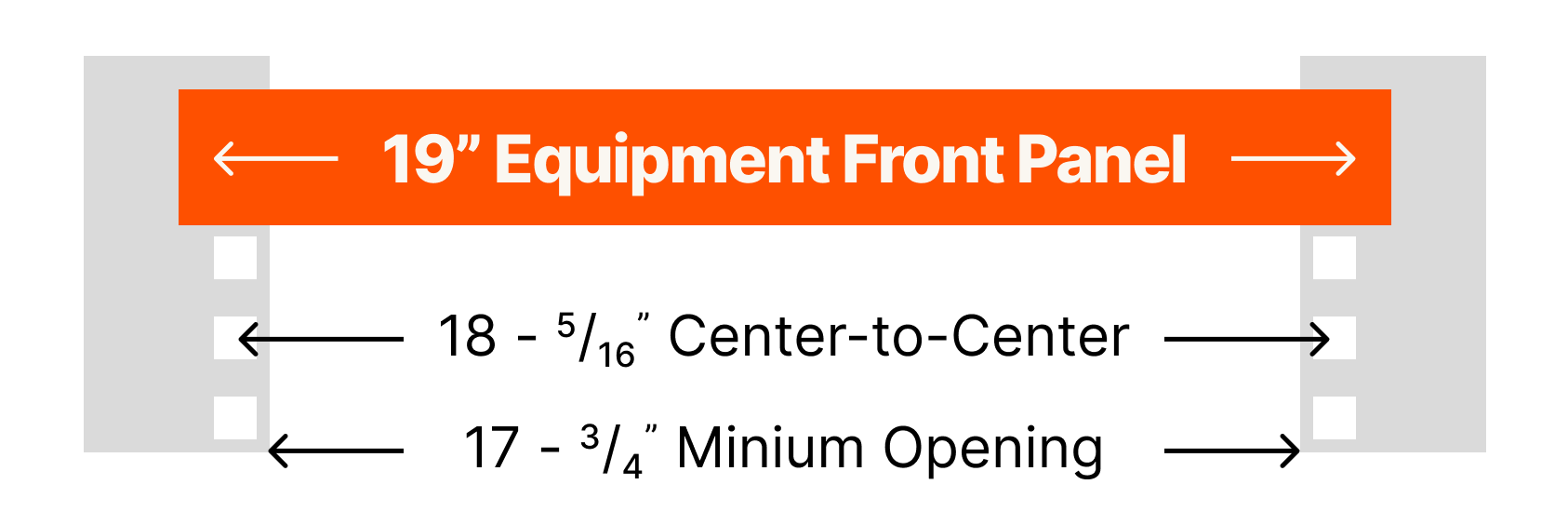
As mentioned earlier, the 19-inch measurement refers to the width of the front panel of the mountable module that slides into the rack and not the chassis of the server itself (which usually needs to be smaller). In other words, we measure from one mounting hole to another.
How to Measure the Server Height
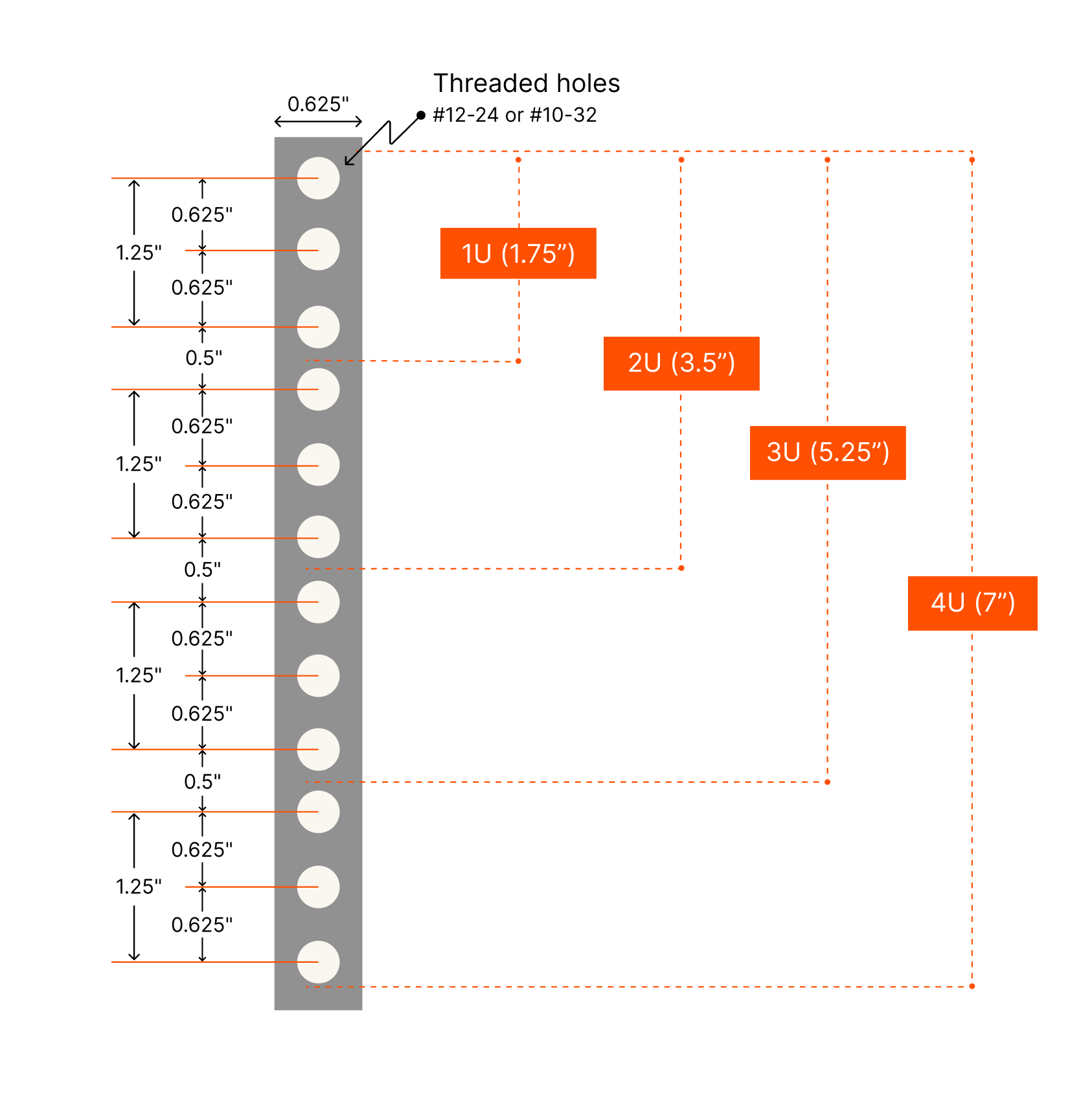
What about the vertical size of a unit? The following diagram shows how the height of a single rack unit 1U is measured.
How to Measure the Server Depth
This dimension is measured from the front of the front mounting post to the back of the back mounting post. Unlike the other two measurements, this one isn’t really standardized and depends on how the cabinets are adjusted once installed. A good rule of thumb is to go by the standard 48-inch floor panel of a data center.
How Many Rack Units Do You Need?
A better question would be to ask: How much performance and capacity do you need? Then size your rack depending on how many servers you’ll need to meet your requirements. Remember to also allow rack units for the power, cooling, and other accessories you may need in your final configuration. If there’s space left over in a standard 42U rack, consider adding shelf space for documentation and tools.
How Do Pure All-flash Storage Arrays Compare to 19-inch Rack Servers?
As a leader in all-flash storage arrays, Everpure can fit a lot of power and capacity into a small form factor that’s sure to fit within your data center. Let’s take a closer look at how we measure the physical dimensions of Pure’s hardware products.
FlashArray Dimensions and Weight
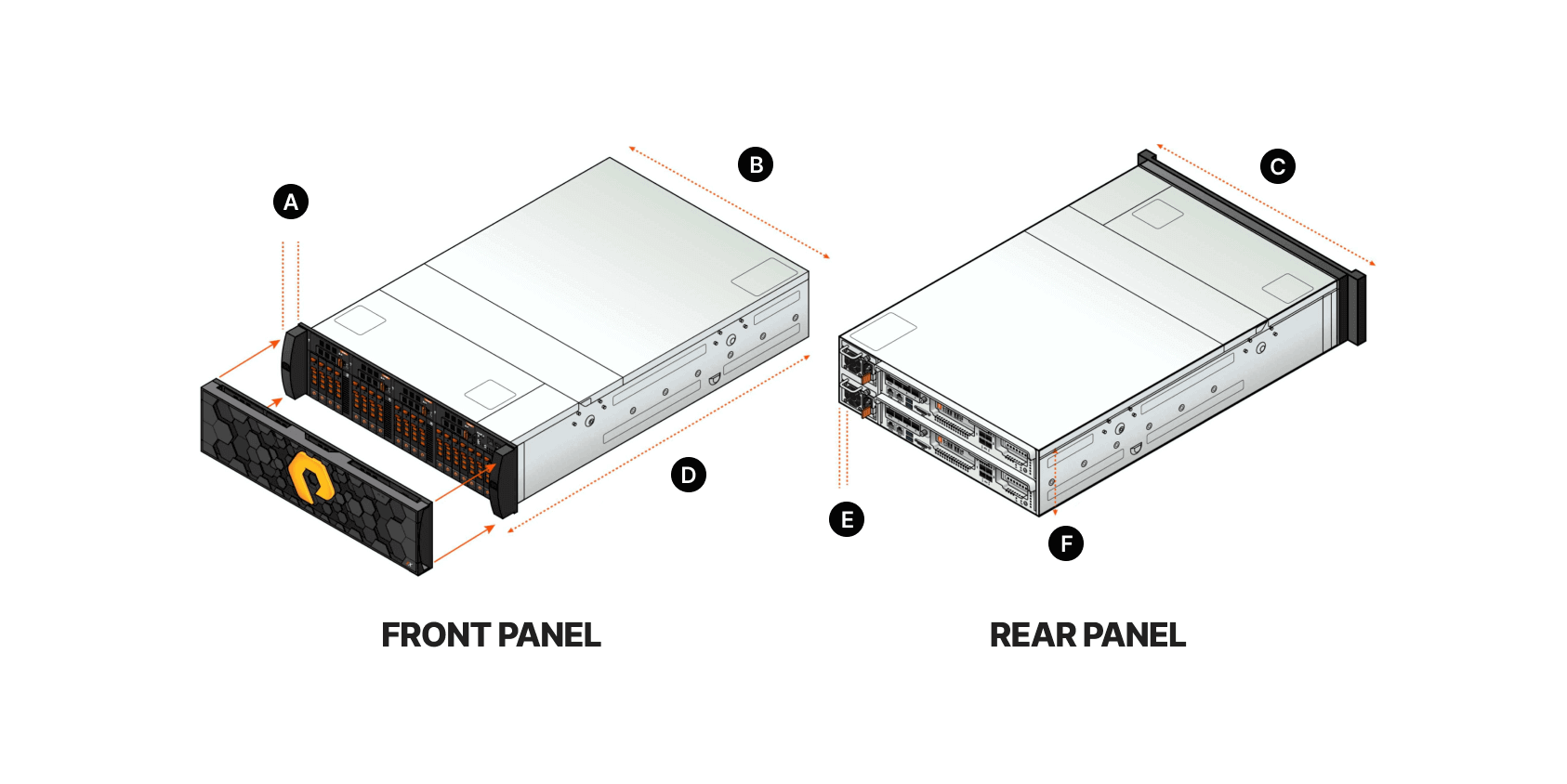
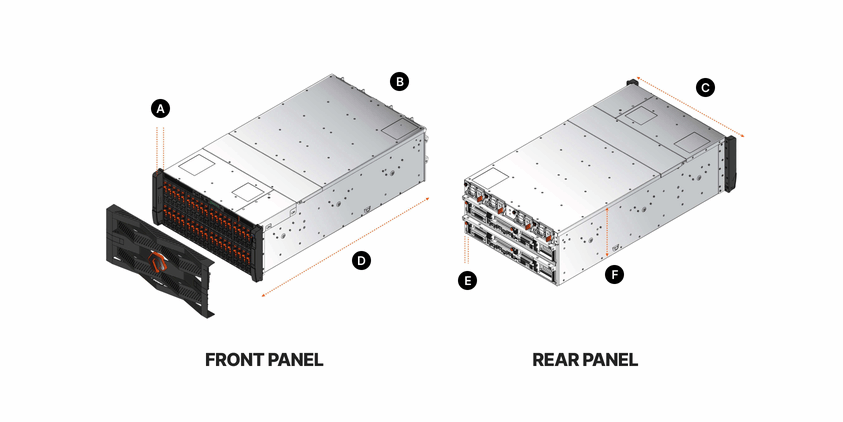
Everpure currently offers three all-flash storage array product lines to address Tier 0, Tier 1, and Tier 2 block storage needs. The following images depict how we measure the chassis of each FlashArray™ device.
FlashArray//X
FlashArray//X is a performance-optimized, all-flash, end-to-end NVMe and NVMe-oF storage array designed to provide block storage for Tier 0 and Tier 1 applications.
FlashArray//XL
FlashArray//XL delivers top-tier performance for capacities and scales beyond FlashArray//X.
FlashArray//C
FlashArray//C is a capacity-optimized, all-flash NVMe storage array for Tier 2 applications.
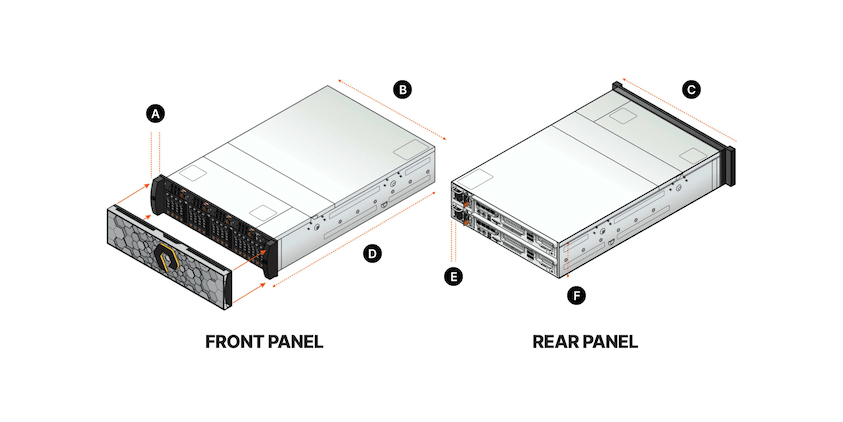
FlashBlade//S Dimensions and Weight
FlashBlade//S™ is the world’s first unified fast file and object (UFFO) storage platform. Leveraging DirectFlash® technology and a storage architecture designed with native flash support for file and object storage from the bottom up, FlashBlade packs a lot of power into a small form factor.
While FlashBlade isn’t technically a rack server, it is one of our most popular products because it packs a lot of power into a small form factor that scales out with your storage needs.
The following are the minimum mounted clearances for each chassis surface:
Front: 91 cm (36 in)
Rear: 61 cm (24 in)
Side: 1.5 cm (0.6 in)
Top and bottom: 0 cm (0 in)
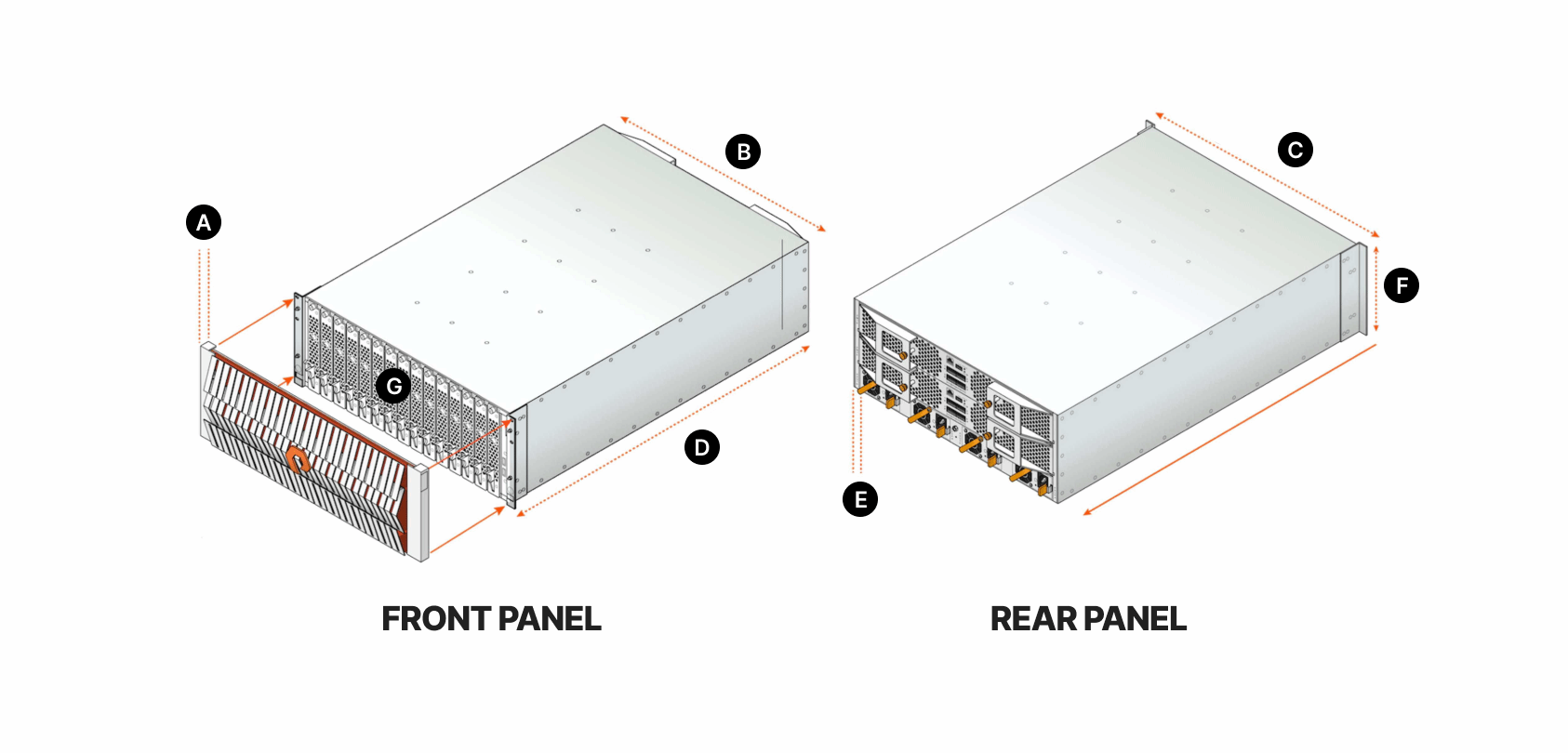
The following image depicts the overall chassis dimensions of FlashBlade (Note: Measurements in the image are in centimeters):
We Also Recommend...
Browse key resources and events

TRADESHOW
Pure Accelerate 2026
June 16-18, 2026 | Resorts World Las Vegas
Get ready for the most valuable event you’ll attend this year.

PURE360 DEMOS
Explore, learn, and experience Everpure.
Access on-demand videos and demos to see what Everpure can do.

VIDEO
Watch: The value of an Enterprise Data Cloud
Charlie Giancarlo on why managing data—not storage—is the future. Discover how a unified approach transforms enterprise IT operations.

BLOG
What’s in a Net Promoter Score?
For nine consecutive years, Everpure has maintained a Net Promoter Score of over 80. Find out how we did it and what it means for our customers.
Personalize for Me
