Dismiss
Innovations
Everpure Simplifies Enterprise AI with Evergreen//One for AI and Data Stream Beta
Accelerate the transition from pilot to production with benchmark-proven performance, automated data pipelines, and a flexible consumption model.
Dismiss
June 16-18, Las Vegas
Pure Accelerate 2026
Discover how to unlock the true value of your data.
Dismiss
Innovation
A platform built for AI
Unified, automated, and ready to turn data into intelligence.
What Is Persistent Memory?
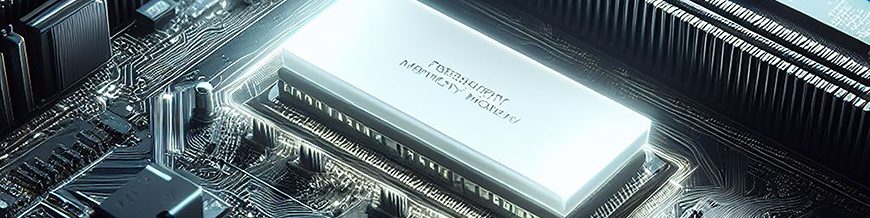
In today's rapidly evolving data landscape, enterprises are constantly searching for innovative storage solutions to enhance capabilities while maximizing cost. As enterprises create more data, high-density, high-performance memory and storage will be critical to managing it all and getting more value from it.
One such advancement was persistent memory, a game-changing technology that represents a new tier in the storage hierarchy. This technology, which emerged in 2019, combines the speed of volatile memory with the data retention of traditional storage devices.
Persistent memory’s early incarnations, such as Intel Optane, have been discontinued, yet the problems it aimed to solve still exist. Here’s a look at what persistent memory could do and where future research may lead.
Related reading: In Remembrance of Optane, Intel’s Persistent Memory Technology
What Is Persistent Memory?
Persistent memory (or, PMEM) is solid-state, high-performance computer memory that retains data even when the power is turned off. Unlike volatile memory, such as random access memory (RAM), which loses all its data when the system is powered down, persistent memory preserves information, enabling faster data access and improved system performance upon reboot.
How Does Persistent Memory Work?
Persistent memory technology was built on non-volatile memory (NVM) components, which store data persistently. This data was directly accessible by the central processing unit (CPU), illustrated above, which meant it could bypass the delays associated with traditional storage devices like hard-disk drives (HDDs) or solid-state drives (SSDs). It also resided directly on the memory bus, which was different because it allowed PMEM to access data like traditional system memory has.
Persistent memory integrates seamlessly into the memory hierarchy illustrated above, residing between volatile memory and storage devices. Examples like Optane operated in a manner similar to RAM but retained data like an SSD, bridging the gap between high-speed memory and durable storage.
PMEM could be run in two modes, offering access to different sets of capabilities:
- Memory mode: A server uses PREM as memory, and DRAM will manage most frequently accessed data while the PMEM provides memory capacity to support big data analytics, virtualized databases, etc. Note: Data is not saved in the event of power loss in this mode.
- App direct mode: Data that doesn’t need to be permanently stored can be executed on DRAM, while data that does need to be persistent can be routed to the PMEM. Rather than having PMEM operating as RAM, it operates as storage. You can put a namespace or file system on top of the PMEM for in-memory databases, big data workloads, and ultrafast storage applications any time you want to take advantage of a fast connection between storage and processor so data can be written back and forth very easily.
Why RAM Isn't Suitable for Persistent Storage
While RAM provides rapid data access, its volatile nature makes it unsuitable for long-term storage. Persistent memory, on the other hand, combines the speed of RAM with the non-volatile characteristics of storage devices, making it ideal for applications requiring both speed and data durability.
Use Cases for Persistent Memory
Persistent memory technology was embraced in various applications, from databases and analytics platforms to artificial intelligence and virtualization. Use cases that could benefit from later incarnations of the technology are those that require ultrafast storage applications, such as:
- In-memory databases such as SAP HANA
- Big data workloads such as Hadoop
- Virtualization: Increasing server performance
- Genomic sequencing: Quick data access accelerates genetic analysis and research
- Machine learning and AI: Fast storage to access training data sets accelerates training times, enabling the development of more sophisticated AI applications.
- IoT data processing: Ultrafast storage solutions enable businesses to extract valuable insights and respond to IoT-generated events promptly.
- Threat analysis in cybersecurity
- Video editing and rendering: Ensuring smooth playback, editing, and rendering of video projects
- Gaming: Gaming applications require fast storage to load game assets, textures, and levels quickly, enhancing the gaming experience by reducing loading times and ensuring seamless gameplay.
Differences between Volatile Storage and Persistent Memory
Volatile storage, represented by RAM, loses data when the system powers down. In contrast, persistent memory retains information, ensuring data integrity and durability. This fundamental distinction is pivotal in enterprise environments where data reliability is paramount.
DRAM vs. Persistent Memory
Dynamic random access memory (DRAM) is fast, but it’s volatile, or “ephemeral.” DRAM can include features such as register, buffering, and error correcting, but even with this resiliency, it will lose data if there’s a power failure or server crash.
As DRAM has become a larger proportion of server costs, persistent memory can combine speed, resiliency, and capacity with non-volatility, making it a great option for applications demanding rapid data access and retention. And, PMEM was largely cheaper per gigabyte than DRAM.
SSDs and HDDs vs. Persistent Memory
Traditional storage devices, such as SSDs and HDDs, offer durability but comparatively slower data access. Persistent memory can overcome this limitation by providing swift access times while preserving data, enhancing both speed and reliability in enterprise storage solutions. Also, unlike flash, PMEM sits directly on the memory bus.
How Is PMEM Integrated into an Existing Architecture?
PMEM represented an important step forward from legacy memory architectures to tiered memory architectures. The key difference was that PMEM sat directly on the memory bus but offered enhanced storage. In this way, it was almost like an entirely new tier in the storage hierarchy.
In a legacy memory architecture, you’d have a single pool of DRAM. However, PMEM allowed for a 1:4 tiered memory architecture. PMEM could act as a capacity tier beneath the DRAM layer, which can act as a fast cache tier. This lets the DRAM handle the performance but with more memory capacity than DRAM alone. Hot data went on the DRAM, and warm data went on PMEM.
The use cases are important, however. It would not be cost-effective to replace all SSDs and HDDs with PMEM. But, enabling optimum performance and capacity without the cost of DRAM was a (short-lived) win.
What about Storage Class Memory (SCM)?
Storage-class memory (SCM) is an overarching term encompassing various non-volatile memory technologies, including persistent memory. Persistent memory, as a subset of SCM, offers high-speed, non-volatile data storage, making it a vital component in modern enterprise architectures.
NVMe vs. PMEM
Non-volatile memory express (NVMe) and persistent memory were complementary technologies. NVMe accelerates data transfer between the CPU and storage devices, while PMEM enhances overall system performance by providing rapid, persistent data access.
Benefits of Persistent Memory
The integration of persistent memory into enterprise systems could yield several advantages, including:
- Enhanced performance
- Reduced latency
- Versatility, with different operating modes that offer access to two different sets of capabilities
- Improved scalability
- Non-volatility ensures ongoing data access, even during an unexpected loss of power, crash, or system shutdown. Persistent memory technology facilitates seamless data persistence, ensuring critical information is safeguarded even during power outages or system failures.
- Better total cost of ownership (TCO) and affordability. As we mentioned above, it’s also larger without increasing cost dramatically. Typical RAM DIMM sizes include 16, 32, 64, 128, and 256GB—but costs increase dramatically with size. With PMEM, sizes start with 128GB, then increase to 256GB and 512GB. Including six of those 512GB devices per processor in a server will deliver three per processor, adding up to 6TB of memory. While the RAM acts as cache and the PMEM acts as RAM, two sockets would be 6TB of RAM.
- Better security for data in-memory with encryption add-ons
Improved Performance with Persistent Memory
By minimizing data access delays, persistent memory could significantly boost application performance. Complex computations, large-scale data processing, and real-time analytics benefitted from the rapid data retrieval enabled by persistent memory technology.
Persistent Memory and Data Persistence
Data persistence is essential in enterprise environments where uninterrupted access to critical information is paramount. Persistent memory guaranteed data retention, enabling businesses to recover swiftly after system failures and ensuring continuous operations.
Was Persistent Memory Scalable?
Yes, persistent memory was highly scalable. Enterprises could expand their storage capacities by adding more persistent memory modules to accommodate growing data requirements.
Potential Downsides of Persistent Memory
While persistent memory offered numerous advantages, there were things to consider such as:
- Compatibility issues
- Higher costs compared to traditional storage
- Limited capacity options
Was Persistent Memory Expensive?
PMEM was best used strategically, for example, when greater system memory was required, as it was more expensive than NVMe SSD and 3D NAND SSD.
Persistent memory modules were more expensive than traditional storage options like HDDs or SSDs. However, the cost differential could likely have been mitigated by performance gains and enhanced data reliability.
Will Persistent Memory Be Resurrected?
Intel’s Optane product line was discontinued, but research could continue to further progress with alternatives to persistent memory, such as memory tiering.
Conclusion
Persistent memory represented a paradigm shift in enterprise storage, offering a potential for a new tier, one based on speed and reliability. Its ability to combine the best aspects of volatile memory and traditional storage devices made it a groundbreaking technology before it was retired.
Looking for the best storage solution in speed and reliability on the market today? Discover what FlashArray™ DirectMemory® Cache can do for you.
Browse key resources and events
TRADESHOW
Pure Accelerate 2026
June 16-18, 2026 | Resorts World Las Vegas
Get ready for the most valuable event you’ll attend this year.
PURE360 DEMOS
Explore, learn, and experience Everpure.
Access on-demand videos and demos to see what Everpure can do.

VIDEO
Watch: The value of an Enterprise Data Cloud
Charlie Giancarlo on why managing data—not storage—is the future. Discover how a unified approach transforms enterprise IT operations.

BLOG
What’s in a Net Promoter Score?
For nine consecutive years, Everpure has maintained a Net Promoter Score of over 80. Find out how we did it and what it means for our customers.
Personalize for Me