Dismiss
Innovations
Everpure Simplifies Enterprise AI with Evergreen//One for AI and Data Stream Beta
Accelerate the transition from pilot to production with benchmark-proven performance, automated data pipelines, and a flexible consumption model.
Dismiss
June 16-18, Las Vegas
Pure Accelerate 2026
Discover how to unlock the true value of your data.
Dismiss
Innovation
A platform built for AI
Unified, automated, and ready to turn data into intelligence.
Knowledge Article
What Is Edge Computing?
Edge computing is redefining the way enterprises process and deliver data. While 91% of today’s data is processed in cloud or on-premises data centers, Gartner predicts that by 2025, edge solutions will process 75% of all data created.
This shift is mainly due to the explosion of IoT devices and applications that require real-time processing power at levels traditional data center solutions can’t provide. But outside of this, the edge also allows organizations to move beyond the limitations of traditional cloud networks to automate core business processes, maximize operational efficiency, and improve performance.
In this article, we’ll look at the edge computing definition. We’ll also explore how edge technology works, its benefits, common use cases, and challenges associated with it.
What Is the Edge?
As the number of devices connected to the internet has increased, so has the volume of data being produced. Moving this much data across from the edge to a central location can be time-consuming and costly.
Uploading large amounts of analytical data can cause network congestion on local networks, depleting the bandwidth resources necessary for other day-to-day business tasks such as video conferencing, which has become essential in today’s remote work environments. Latency, the time it takes to transfer data from its source to its destination, is also a concern for applications that rely on real-time data. Deploying at the edge keeps storage and servers where the data is.
Edge computing is a distributed computing architecture that places applications, data, and compute resources geographically closer to where data is being collected and analyzed. Data is processed at the extremities of the network, as close to the original source as possible. Instead of sending all data to a centralized data center hundreds of miles away, the edge sends only the optimized data.
Edge technology finds its origins in the content delivery networks (CDNs) of the ’90s, but the technology is advancing today due to the large volumes of data being generated by IoT devices and an increase in real-time application development that requires reduced data transfer times and lower bandwidth costs.
How the Edge Works
Cloud technology has brought enterprises several advantages, including increased scalability, agility, and reduced costs. However, there are still issues related to latency, bandwidth, and security. Edge computing decentralizes processing from a primary data center by collecting and processing data from devices and applications on-site.
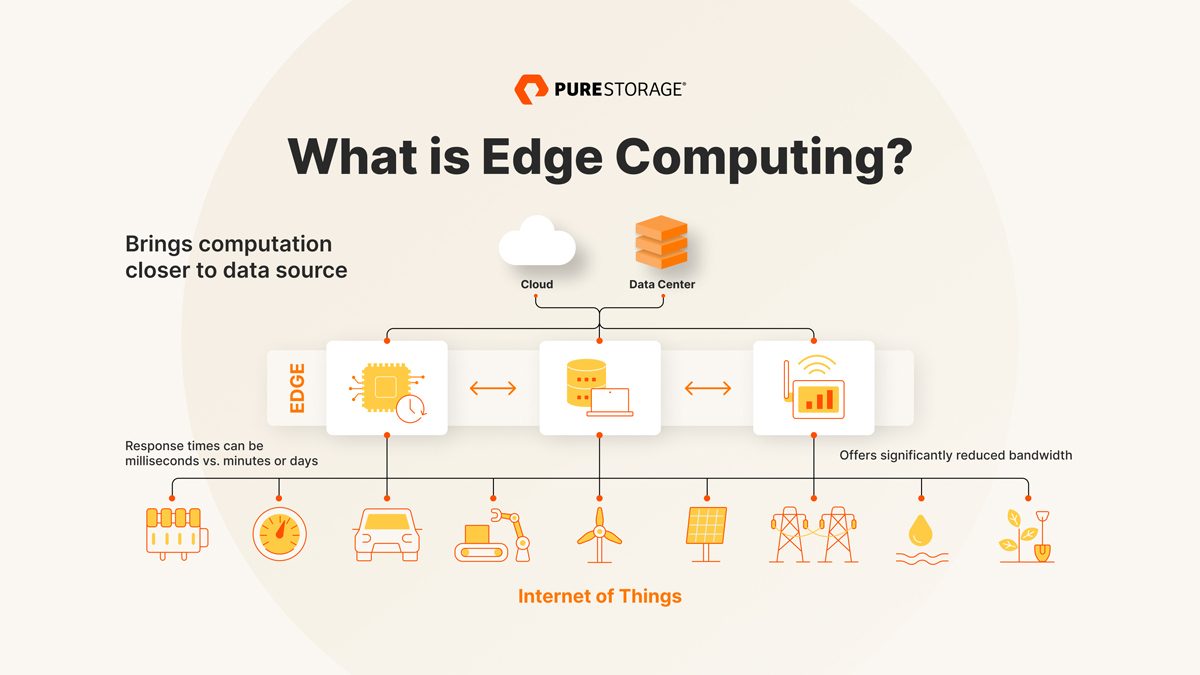
An edge gateway connects the edge to a cloud or enterprise data center, provides translation between different network protocols, and manages the flow of data to ensure that only optimized data is sent to the data center.
Edge infrastructure can include edge servers, edge storage and gateways, IoT devices, sensors, desktops, laptops, smart devices, and machinery that collect and process data in real time.
Edge Storage
It can also include smaller secondary edge data centers in nearby cities or rural areas, or cloud containers that can be moved across cloud environments and systems. Where necessary, infrastructure is deployed in protected enclosures to shield against extreme temperature and other environmental conditions.
Types of Edge Computing
The following are three specific types of edge computing:
Sensor Edge
Edge sensors act as triggers for collecting data or monitoring and sending events. Sensors are optimized for a specific purpose, with basic edge functionality built in. Edge sensors typically have little to no processing capability and can only communicate with the edge network, cloud, or data center. Examples include clocks, surveillance cameras, industrial controllers, and time-series databases.
Device Edge
Edge devices live on the last mile of the network and usually have limited power, compute, and storage functionality. Devices depend on a gateway to collect and process data from the device and are usually in proximity to computing resources to help reduce latency, bandwidth usage, and communication issues. Device edge is often used in remote locations where a data center isn’t a feasible option (e.g., wind turbines, oil rigs, and places that experience extreme weather).
Mobile Edge
Mobile services are distributed on networks positioned close to the customer for optimal service. Mobile edge computing (MEC), also known as multi-access edge computing, is a highly distributed network that sits on the outermost edge of the network and allows computing, storage, and networking resources to be integrated into base stations on the network so that applications and services can be deployed closer to mobile users.
With MEC, service providers can move workloads from the cloud to local servers to provide a better user experience and reduce latency and congestion on the network.
Benefits of Edge Computing
Edge computing provides several benefits to enterprises that rely on time-sensitive applications or need to move large amounts of data. Some of the major benefits of edge computing include:
Greater resilience: An edge platform supports faster, more consistent, and more reliable services. Because computing power is local, sites on the edge can continue to operate independently if the central data center goes down.
Reduced latency: Real-time data delivery is critical for technologies like medical IoT devices and self-driving vehicles, where the slightest delay could cause loss of life. Network congestion and outages can delay data delivery, reducing the ability of a system to respond in real time, leading to delayed analytics and decision-making. With edge computing, critical data can be processed closer to the device for faster response items.
Lower bandwidth usage: Networks have finite bandwidth limits that determine the amount of data and devices that can communicate across the network. Increasing network bandwidth to accommodate more devices and data comes at significantly higher costs. Instead of constantly streaming data and consuming large amounts of bandwidth, edge computing only processes and delivers the most important data to the data center.
Greater security and sovereignty: Data security, privacy, and other legal considerations must be considered when moving data across international and regional boundaries. Processing data at the edge creates an opportunity to implement measures to secure and obscure data before sending it to the cloud or data center, which may be governed by different data security laws.
Lower costs: Edge solutions can often be implemented at lower costs than centralized data centers, whether in the cloud or on-premises. Edge computing also reduces connectivity costs by moving smaller amounts of data between the edge and data centers.
Edge Computing Use Cases
Edge computing is seeing increased use in several industries, including telecommunications, manufacturing, transportation, and utilities. Top use cases include:
Manufacturing: Using condition-based monitoring, manufacturers can perform maintenance services based on the actual condition of the machinery, while predictive maintenance can proactively detect machine failure and perform maintenance before a potential breakdown.
Precision monitoring and control allow manufacturers to use data from multiple systems, processes, and machines to monitor for production errors and provide real-time insights to improve manufacturing processes and quality.
Agriculture: Farmers rely on edge technology to help track water use, dispense fertilizer in the right amounts, examine soil quality, and monitor the progress of crops in outlying fields. Farmers can also collect and analyze data from a wide range of connected devices, including sensors and tractors to observe environmental effects and improve crop-growing practices.
Healthcare: The healthcare industry collects a tremendous amount of patient data from health monitors, sensors, and other medical devices. IoT edge computing makes it possible to collect and analyze critical patient data, as well as to apply automation and machine learning to identify anomalies. This gives healthcare professionals access to real-time analytics so that they can take immediate action in diagnosing and treating health issues.
Transportation: Because autonomous vehicles need to analyze data in real time to operate safely and effectively, sending data to a remote data center isn’t an option. Vehicles need to aggregate and process enormous amounts of data from multiple sources to make real-time decisions about navigation and communicate with other vehicles, all while in motion.
Onboard edge technology allows autonomous vehicles to perform real-time analysis on location, speed, and other vehicle-related data to determine the best routes and avoid traffic congestion.
Augmented reality (AR): Augmented reality applications for retail, education, and entertainment involve intense rendering operations that require real-time responses and low latency to function effectively. AR experiences delivered using centralized computing services can incur high bandwidth costs and be subject to high latency, lessening the user experience.
5G edge computing, the combination of edge computing and 5G connectivity, can provide faster and more reliable connectivity for AR applications. Edge computing can also divide workload processing between the AR device and the edge network to support an optimal user experience.
Pure Solves Your Edge Computing Challenges
Implementing an edge solution can present several challenges. Because edge solutions are designed to handle a specific purpose, they’ll use limited resources and have limited capability.
The scope and purpose of your edge solution must be clearly defined for it to be effective. You also need to figure out the minimum level of connectivity needed, determine the data life cycles, and implement an overall security plan.
To help solve your edge computing challenges, Everpure offers several solutions, including:
FlashBlade®: Is the world’s leading unified fast file and object (UFFO) platform. It’s ideally suited for analytics, machine learning, artificial intelligence, and similar edge data processes.
FlashArray™: Combines the high performance of all-flash storage with VMware integration to create a hybrid-cloud solution. It supports a 5G multimode infrastructure that combines virtual machines and containers.
The high-density, low power consumption and easy remote management of both FlashBlade and FlashArray make them ideal for deployments at edge locations.
Portworx®: Provides a storage layer for running cloud-native workloads at the edge. It delivers a complete solution for containerized workloads, including backup and disaster recovery. Portworx integrates with both FlashBlade and FlashArray for high performance and reliability.
Browse key resources and events
TRADESHOW
Pure Accelerate 2026
June 16-18, 2026 | Resorts World Las Vegas
Get ready for the most valuable event you’ll attend this year.
PURE360 DEMOS
Explore, learn, and experience Everpure.
Access on-demand videos and demos to see what Everpure can do.

VIDEO
Watch: The value of an Enterprise Data Cloud
Charlie Giancarlo on why managing data—not storage—is the future. Discover how a unified approach transforms enterprise IT operations.

RESOURCE
Legacy storage can’t power the future
Modern workloads demand AI-ready speed, security, and scale. Is your stack ready?
Personalize for Me