Dismiss
June 16-18, Las Vegas
Pure Accelerate 2026
Discover how to unlock the true value of your data.
Dismiss
Innovation
A platform built for AI
Unified, automated, and ready to turn data into intelligence.
Dismiss
The Everpure Advantage
Thrive through volatility
Stop absorbing volatility. With efficiency and predictability built in, you stay in control.
What Is a Multicloud?

What Is a Multicloud?
A multicloud abstracts away the complexities of managing multiple cloud services from different cloud providers of the same type (i.e., public or private), by consolidating them into a single unified data plane.
What's the Appeal of Multicloud Solutions?
It’s a situation that’s all too familiar to anyone who’s had to deal with enterprise cloud deployments: You thought you’d found the perfect public cloud solution with the right blend of service-level agreements (SLAs), security, performance, and cost to support a specific customer-facing feature in your custom app. Later on, you find yourself in need of a critical feature that’s only available in a different public cloud provider’s proprietary app. To integrate this new service into your app for scalability, the vendor requires you to also host the app in its proprietary public cloud.
Since no one cloud app is perfect, you continue to repeat this process over and over again as your app grows and develops to maintain your competitive advantage. Before you know it, your IT team is overwhelmed managing this disparate collection of public cloud apps. At some point, it becomes clear that it’s time to invest in a multicloud solution that helps you consolidate all these public cloud resources into a single unified interface.
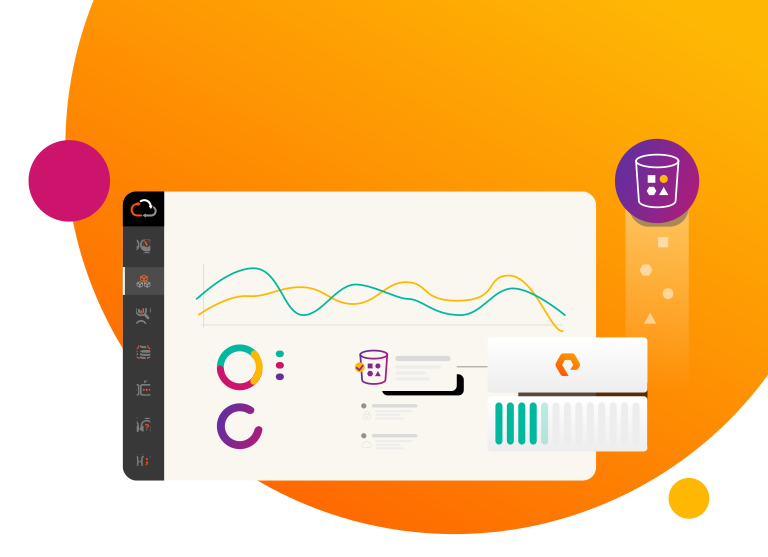
Test Drive FlashBlade
Experience a self-service instance of Pure1® to manage Pure FlashBlade™, the industry's most advanced solution delivering native scale-out file and object storage.
Multicloud vs. Hybrid cloud: What’s the difference?
Although it may be tempting to use the two terms interchangeably, they’re not mutually exclusive. A multicloud architecture could involve the unification of two private clouds or two public clouds, but the moment you unify public and private cloud environments, you’re dealing with a hybrid cloud architecture. Here’s a closer look at each solution:
Multicloud
- Features separate clouds for separate tasks often from different cloud providers
- Can have both public and private clouds working together as separate silos (i.e., they can’t share resources for load balancing across the public/private divide) and performing separate functions
- Example: An enterprise app that uses one public cloud app for a platform-as-a-service (PaaS) feature, another public cloud app for a software as-a-service (SaaS) feature, and a private cloud app for an infrastructure-as-a-service (IaaS) feature
Hybrid cloud
- Has different public and private clouds that can work together to perform the same task
- Enables the availability of the same task to storage and compute resources across public and private clouds for load balancing and cost optimization
- Example: An enterprise app that can divert resources from its private cloud to support its SaaS app during peak loads (abstracting away the details of dealing with the different service providers)
A multicloud approach involves using different clouds to handle different tasks while a hybrid cloud involves using your public and private cloud resources together to support the same task. It’s possible for a multicloud to also be part of a larger hybrid cloud depending on how you deploy your services.
The Benefits of Multicloud
The main benefits of a multicloud architecture include:
- Reduced vendor lock-in: Work with the cloud providers you want when you want.
- Improved redundancy: When one feature goes down, others are still available.
- Optimized features: Pick the best cloud provider by price and performance for the feature you’re trying to provide.
Why Choose Everpure for Multicloud?
Everpure unifies hybrid and multicloud ecosystems into a single agile data plane. Everpure offers a true hybrid cloud that provides:
- All the benefits of multicloud but with the flexibility to operate as a hybrid cloud
- Effortless data and app mobility across public and private clouds
- The native performance of Pure’s on-premises NVMe all-flash storage arrays
- A single unified interface for all cloud resources with Everpure Cloud Dedicated
Eliminate the complexity of siloed private and public cloud environments today with Everpure.
Browse key resources and events
TRADESHOW
Pure Accelerate 2026
June 16-18, 2026 | Resorts World Las Vegas
Get ready for the most valuable event you’ll attend this year.
PURE360 DEMOS
Explore, learn, and experience Everpure.
Access on-demand videos and demos to see what Everpure can do.

VIDEO
Watch: The value of an Enterprise Data Cloud
Charlie Giancarlo on why managing data—not storage—is the future. Discover how a unified approach transforms enterprise IT operations.

BLOG
What’s in a Net Promoter Score?
For nine consecutive years, Everpure has maintained a Net Promoter Score of over 80. Find out how we did it and what it means for our customers.
Personalize for Me