Dismiss
Innovations
Everpure Simplifies Enterprise AI with Evergreen//One for AI and Data Stream Beta
Accelerate the transition from pilot to production with benchmark-proven performance, automated data pipelines, and a flexible consumption model.
Dismiss
June 16-18, Las Vegas
Pure Accelerate 2026
Discover how to unlock the true value of your data.
Dismiss
Innovation
A platform built for AI
Unified, automated, and ready to turn data into intelligence.
Back to Basics: What Is Backup and Recovery

It's no secret that data is a necessary component of our day-to-day lives, both personally and professionally. But many of us are still waking up to how easily and quickly a disruptive event can make it disappear.
Data is stored in various ways, and there are just as many ways, if not more, it can be lost. Losing some photos from your vacation might be annoying, but it pales in comparison to losing critical customer information due to data failure.
Luckily, backup and recovery solutions like FlashBlade® Rapid Restore can help you combat potential data loss scenarios.
Backup and recovery solutions not only provide peace of mind but also help protect your bottom line. Your company could end up losing a significant amount of money from just a few minutes of downtime.
For example, it's estimated that for every hour of downtime a Fortune 1000 enterprise experiences, the organization loses an average of $500,000 to $1,000,000. On top of that, there are also costs associated with damage to the company’s reputation and loss of customer confidence.
It's common for businesses to underestimate how vulnerable their data is to potential disasters both artificial and natural. Hardware failures, user errors, ransomware attacks, and other unfortunate events can all result in essential data being deleted or corrupted.
In this article, we’ll explore what data backup and recovery is, how it works, and what you should look out for when searching for a modern backup and recovery solution for your business.
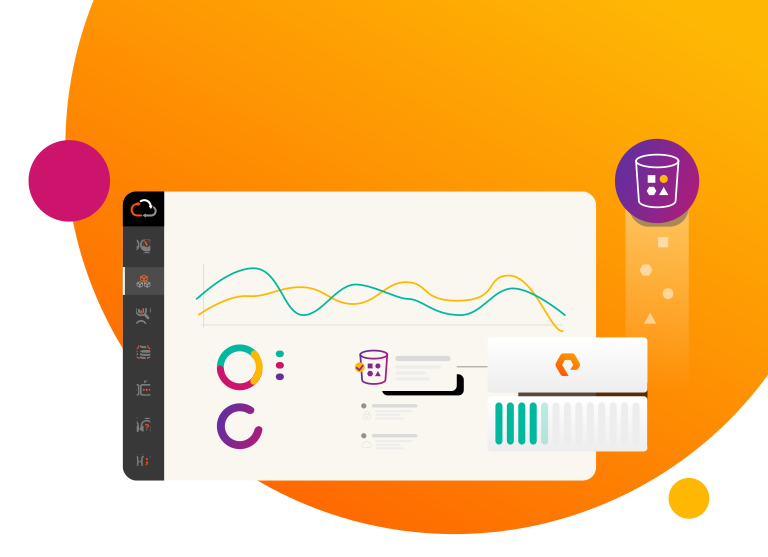
Test Drive FlashBlade
Experience a self-service instance of Pure1® to manage Pure FlashBlade™, the industry's most advanced solution delivering native scale-out file and object storage.
What Is Backup and Recovery?
Backup and recovery refers to the practice of creating and storing copies of your data that you can use to restore your organization’s services in the event of a primary data failure due to a power outage, ransomware attack, or other type of disaster. Backups allow you to roll back your systems to a previous point in time before the data loss or corruption occurred to restore services.
While you could store backups on the same server as the original data, it’s considered best practice to store them on a different server or separate system such as a secure cloud server to create data redundancy.
When considering backup and recovery solutions for your organization, it's important to identify your recovery time objectives (RTOs) and recovery point objectives (RPOs). You’ll want to know how long it will take to restore backups and how recent the data will be.
Backups vs. Snapshots
The difference between these two terms is in the details. A backup generally refers to a complete copy of all the data and files in your system. Meanwhile, a snapshot copies the state of a system at a certain point in time.
What are Backups?
Backups are complete copies of your system files. The process of backing up these files can take anywhere from minutes to hours, depending on the amount of data you're dealing with and the type of backup you're performing.
They're designed for long-term storage and ideally should be kept somewhere other than your original server. That could be a separate hard drive or an entirely different server location.
Backups are a standard component of business continuity and disaster recovery (BCDR) plans.
What are Snapshots?
Snapshots preserve a virtual picture of your server's file system and settings at a specific moment in time. Unlike a backup which performs a full copy of your data, a snapshot only copies the settings and metadata needed to restore your data in the event of a disruption. It’s an important distinction because you will still need to store the source files for your snapshots in a separate location to be able to retrieve them.
When you restore your system with a snapshot, you revert it back to how it was the moment the snapshot was taken. Snapshots are ideal for short-term storage—often used for development and testing purposes. When space for your snapshots runs out, new snapshots will simply overwrite older ones.
Snapshots are handy when you want to perform a "quick save" of your system before installing a major update, for example. If you’re not happy with the results of the update, you can simply roll back to your last snapshot to restore your system to its previous state.
Full vs. Incremental vs. Differential Backups and Restoration
There are three basic ways to back up systems: full, incremental, and differential.
Each has benefits and tradeoffs, so it's essential to know how each one works before selecting one. You may even decide to use a combination of them.
- Full-image backup and restoration: This method creates a backup of all of your data to use as a restore point you can easily roll back to. Full backups arguably provide the best data protection, but they're also the most time-consuming. Organizations that use full-image backups don't usually do them on a daily basis because it would require a significant amount of disk space.
Restoration with full-image backups is fast, but the backup process to create them is time-consuming. As a result, your system data would likely have changed since you performed the last full backup. Any changes that occurred after the last full backup will not be restored. This method isn't ideal for organizations with shorter RTOs/RPOs.
- Incremental backup and restoration: This method backs up your data incrementally. It starts with a single full backup, then backs up only data that has been altered since the last backup.
The downside to incremental backups is that they can take a while to restore because restoration also occurs incrementally. To restore the data, you first have to implement the most recent full backup and then also apply each subsequent incremental backup to your RPO.
- Differential backup and restoration: Like incremental backups, differential backup also starts with a full backup and then subsequently only backs up data that has changed. Restoration is generally faster with this method. It requires two files: the previous full-image backup and the most recent differential backup.
Experience Modern Backup and Recovery with Everpure
Big data is becoming bigger, faster, and multidimensional. The siloed nature of legacy data storage solutions is a major bottleneck for organizations trying to keep up with increasingly stringent RTO and RPO requirements.
Everpure solutions boast many data protection features that can help you reach your RTO and RPO goals. Key benefits include:
- Accelerated recovery for Tier 1 dev/test environments, analytics, IT sandboxes, and backups
- Faster database backups for Oracle Recovery Manager, Microsoft SQL Server, and MySQL
- Built-in protection against ransomware with SafeMode snapshots
- Zero RPO through synchronous replication across networks and zero RTO through transparent failover with Purity ActiveCluster™
Securing your organization's critical data shouldn't be a hassle that distracts you from doing business. That’s why we designed our products to be as intuitive as they are reliable.
We Also Recommend...
Browse key resources and events
TRADESHOW
Pure Accelerate 2026
June 16-18, 2026 | Resorts World Las Vegas
Get ready for the most valuable event you’ll attend this year.
PURE360 DEMOS
Explore, learn, and experience Everpure.
Access on-demand videos and demos to see what Everpure can do.

VIDEO
Watch: The value of an Enterprise Data Cloud
Charlie Giancarlo on why managing data—not storage—is the future. Discover how a unified approach transforms enterprise IT operations.

RESOURCE
Legacy storage can’t power the future
Modern workloads demand AI-ready speed, security, and scale. Is your stack ready?
Personalize for Me